
The telecommunications industry has moved through several major technological shifts. It began with the traditional telephone network, moved to VoIP, cloud communications, and now we’re in the AI-powered voice services era. This educational series follows that evolution step by step, explaining the technologies behind modern communications in plain language. In this article, we discuss the SIP protocol.
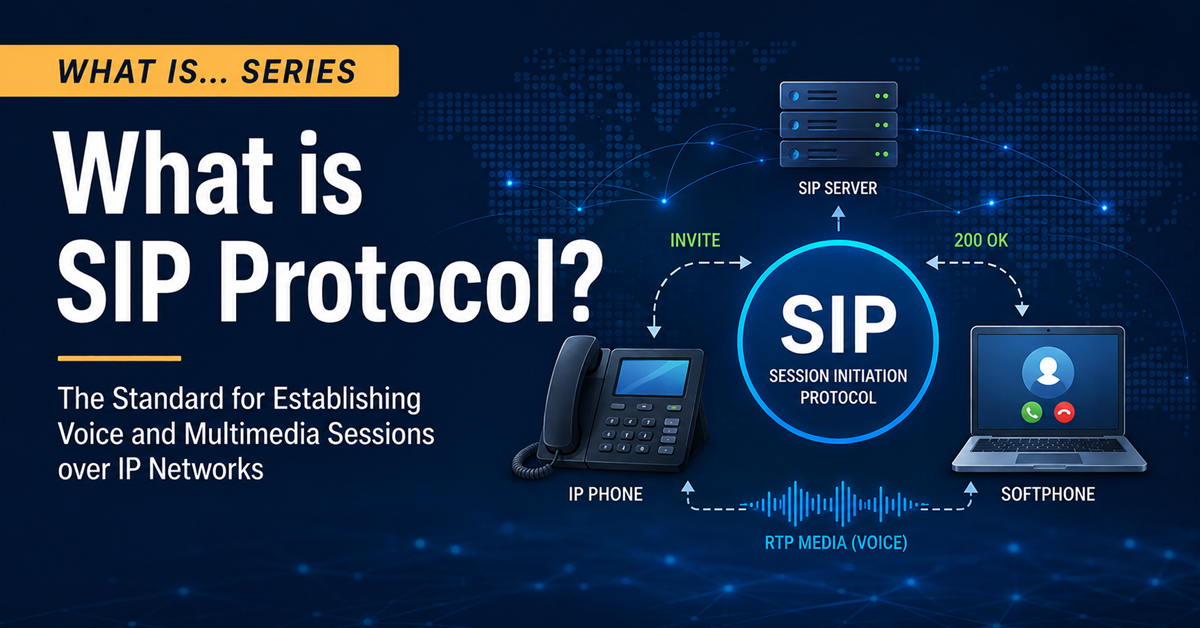
After exploring the PSTN and then VoIP, the next question is how VoIP calls are actually established and managed. This brings us to the SIP protocol, one of the most important building blocks of modern IP communications.
What is the SIP protocol?
The SIP protocol, short for Session Initiation Protocol, is an application-layer signaling protocol used to establish, modify, manage, and terminate real-time communication sessions over IP networks. These sessions can include voice calls, video calls, conferences, and other multimedia communications.
SIP became widely adopted as the telecommunications industry moved from circuit-switched telephone networks toward VoIP. Today, the SIP protocol is used by VoIP platforms, IP phones, PBX systems, SIP trunks, contact centers, and Unified Communications solutions.
Understanding SIP also helps explain how many of the technologies explored later in this series fit together.
How does SIP work?
The SIP protocol provides a standardized way for communication devices and applications to find one another and establish a session.
Imagine making a VoIP call. Before you can start talking, several things need to happen:
- The system must determine where the person you are calling can be reached.
- The recipient’s device must be alerted.
- The endpoints must agree on how the session will work.
- The caller must learn whether the call was accepted, rejected, or redirected.
SIP coordinates these signaling actions.
The Session Initiation Protocol uses a request-and-response model that will look familiar to anyone who understands protocols such as HTTP. One system sends a SIP request, another processes it, and the receiving system returns a response.
The protocol was standardized by the Internet Engineering Task Force (IETF), with RFC 3261 serving as the core SIP specification.
Why does VoIP need SIP?
In our previous article, we explained how VoIP converts voice into digital information that can travel across IP networks. However, transmitting audio is only one part of making a phone call.
A VoIP platform also needs to know:
- Who is calling.
- Which destination the caller wants to reach.
- Whether that destination is available.
- Which media formats the endpoints support.
- What should happen when the call ends.
The SIP protocol provides much of this signaling.
For example, when you dial a colleague’s extension on an IP phone, SIP can initiate the call and communicate with the systems responsible for locating that extension. If your colleague answers, SIP helps establish the session. If they decline the call or are unavailable, the system communicates that information as well.
The relationship between VoIP and SIP is important. VoIP describes the broader technology of carrying voice communications over IP networks, while SIP is one widely adopted method for managing communication sessions.
SIP does not define every part of a VoIP system. In particular, it normally handles signaling rather than transporting the voice itself.
SIP call flow
Suppose Alice wants to call Bob through a VoIP service. When Alice dials Bob’s number, her phone or softphone sends a SIP message called an INVITE.
The INVITE indicates that Alice wants to establish a communication session. It may also include Session Description Protocol (SDP) information describing the proposed media session, including supported codecs, IP addresses, ports, and media types.
The request may travel through one or more SIP servers before reaching Bob’s device.
Bob’s device, or a server acting on its behalf, then responds. Several responses may occur during the process:
- 100 Trying indicates that the request has been received and is being processed.
- 180 Ringing indicates that Bob’s device is alerting the user.
- 200 OK indicates that Bob has accepted the session.
After receiving the successful response, Alice’s device sends an ACK. The signaling exchange is then complete, and the media session can begin.
A simplified call flow looks like this:
INVITE → 100 Trying → 180 Ringing → 200 OK → ACK → Media session
When either Alice or Bob ends the call, that endpoint sends a BYE request. The other endpoint confirms the request with a 200 OK response, and the session is terminated.
In some architectures, SIP-based network elements such as SBCs or B2BUAs may also anchor or relay media. But the basic purpose of SIP remains session signaling and control. This request-and-response process is one of the fundamental mechanisms of the SIP protocol.
Does SIP carry the voice?
Understanding the distinction between signaling and media is essential when learning about the SIP protocol.
SIP generally manages the communication session. The actual audio of a SIP voice call is commonly transported using the Real-time Transport Protocol, or RTP. RTP provides transport functions for real-time audio, video, and similar data streams.
Think about what happens when two people arrange a meeting. They first agree on where and when to meet. Once the meeting begins, their conversation is separate from the process used to arrange it.
SIP performs a similar coordination role for a VoIP session.
The SIP protocol establishes the call and carries signaling information, while SDP helps the endpoints agree on media settings. RTP then commonly carries the stream of voice packets between participants. In simple terms:
- SIP sets up, modifies, and ends the session.
- SDP describes how the media session should work.
- RTP carries the audio or video.
- RTCP can provide control and monitoring information related to RTP.
This architecture makes SIP flexible enough to support more than traditional voice calls. The same signaling concepts can be used for video, conferencing, and other real-time multimedia sessions.
What is SDP?
Before two devices exchange media, they need to agree on how that communication should happen. This is where the Session Description Protocol, or SDP, comes into play.
SDP describes characteristics of a multimedia session, including:
- The types of media involved
- Supported codecs
- Network addresses
- Transport ports
- Media direction, such as send-only or send-and-receive
- Other parameters required to establish the media connection
SDP information is commonly included inside SIP messages during call setup. The SIP protocol carries the signaling, while SDP describes the proposed and accepted media configuration.
For example, one endpoint might indicate that it supports several audio codecs. The other endpoint can respond with compatible capabilities, allowing the systems to determine which codec and media settings to use.
This offer-and-answer process is defined by RFC 3264, while the current Session Description Protocol specification is defined in RFC 8866.
Together, SIP and SDP help endpoints establish compatible communication sessions.
SIP addresses and SIP URIs
The SIP protocol also needs a way to identify users and communication endpoints. SIP frequently uses addresses known as SIP Uniform Resource Identifiers, or SIP URIs.
A SIP URI can look somewhat like an email address: sip:alice@example.com
The user portion typically identifies a user or endpoint, while the domain helps determine which system is responsible for that user.
SIP URIs can also include additional information, such as a transport parameter or port number. A sips URI can be used when SIP signaling is required to follow a secured path using TLS.
In business telephony, users do not necessarily see SIP addresses because phone numbers and extensions provide a more familiar interface. Behind the scenes, however, a VoIP platform may combine SIP identities, telephone numbers, dial plans, and routing rules to determine where calls should go.
A telephone number is not automatically the same thing as a SIP identity. Instead, a phone number may be mapped to a SIP URI through a carrier, PBX, gateway, or other routing system.
What are SIP servers?
SIP communications often involve servers that help locate users and route signaling messages. These functions may be provided by separate systems or combined within the same platform.
Common SIP server roles include:
- Proxy server: Receives SIP requests and forwards them toward their destination.
- Registrar: Accepts registration requests from users or devices.
- Location service: Maintains information about where a user or endpoint can currently be reached.
- Redirect server: Returns alternative destination information instead of forwarding the request itself.
- Back-to-back user agent: Acts as two separate SIP user agents and can control both sides of a signaling relationship.
Consider an employee who uses the same business extension from an IP phone at the office and a softphone while working remotely. Registration mechanisms allow the communications platform to maintain information about where that user can currently receive calls.
These capabilities have helped make the SIP protocol particularly useful for flexible and distributed business communications.
Does SIP use UDP or TCP?
The Session Initiation Protocol can operate over several transport options. SIP deployments may use UDP, TCP, or SCTP, depending on the environment and implementation. RFC 3261 also defines TLS as a secure SIP transport. In this context, TLS generally operates over TCP.
The appropriate choice depends on factors such as:
- Network architecture.
- Message size.
- Reliability requirements.
- Interoperability with carriers and devices.
- Firewall and NAT behavior.
- Security requirements.
UDP can reduce connection overhead, but it does not provide transport-level reliability. TCP provides a reliable connection and can be useful for larger SIP messages or environments requiring connection-oriented transport. TLS adds encryption and authentication to protect SIP signaling in transit.
Security is especially important because signaling can contain valuable information about calls and participants. When deploying SIP-based communication systems, organizations should consider many aspects, such as:
- Authentication
- Encryption
- Access control
- Network segmentation
- Fraud prevention
- Secure firewall policies
SIP signaling security and media security are related but separate concerns. TLS can protect signaling, while SRTP is commonly used to protect RTP media. DTLS-SRTP is another media-security mechanism, particularly common in WebRTC-related environments.
What are the benefits of SIP?
The widespread adoption of the SIP protocol has played an important role in the evolution of business communications.
Open standards
SIP is based on open standards. This allows equipment and services from different vendors to communicate when they implement compatible specifications. This interoperability gives organizations more freedom when designing communication environments.
Interoperability is not automatic. Differences in codecs, extensions, authentication methods, network behavior, and vendor-specific features can still create compatibility issues.
Scalability
SIP also supports scalability. Businesses can add users, locations, devices, and communication services without recreating the physical telephone infrastructure traditionally associated with business telephony.
A company can use SIP-based services across offices, remote locations, mobile applications, and cloud platforms. Centralized provisioning and registration can also make it easier to manage distributed users.
Flexibility
Another major advantage is flexibility. SIP can support voice, video, conferencing, messaging, and other multimedia sessions across different devices and networks.
These characteristics have helped SIP become a core technology behind cloud PBXs, Unified Communications platforms, contact centers, SIP trunks, and modern voice services.
SIP and AI communications
The importance of SIP continues as artificial intelligence changes telecommunications.
Voice AI agents, intelligent contact centers, automated receptionists, and conversational systems still need reliable ways to connect with callers and existing telephone infrastructure. SIP provides a mature signaling framework that can help bridge established telecom networks with newer software and AI platforms.
For example, a customer might dial an ordinary telephone number while the call is ultimately handled by an AI voice agent operating in the cloud.
Behind that seemingly simple interaction may be a combination of:
- PSTN connectivity
- VoIP infrastructure
- The SIP protocol
- RTP or another media transport
- Speech recognition
- Text-to-speech processing
- Artificial intelligence
- Business applications and databases
The SIP protocol does not provide the AI capabilities itself. Instead, it can provide the signaling layer that connects the call to software responsible for speech processing, automation, and business logic.
Understanding each layer makes today’s rapidly changing communications landscape easier to navigate.
Why understanding SIP matters
Learning about the SIP protocol connects several important pieces of the telecommunications story.
We started this series with the PSTN, the traditional network that established global telephone communication. We then explored VoIP and saw how voice could move onto IP networks. SIP provides a widely used signaling method for establishing, modifying, and terminating many of those IP-based communication sessions.
The story continues with SIP trunking. This technology enables organizations to use SIP-based connectivity to link business phone systems or cloud PBXs with external telephone networks.
Cloud communications, Unified Communications, and voice AI continue to reshape the industry. And the SIP protocol remains an important part of the infrastructure connecting established telecommunications with the services built for the future.


Leave a comment