
Before AI-powered phone agents, cloud contact centers, and Unified Communications began transforming the telecommunications industry, one technology fundamentally changed how people made phone calls: Voice over Internet Protocol. In the previous article, we explored PSTN, the traditional telephone network that connected the world for more than a century. The next logical step in our series is answering another essential question: What is VoIP?
Understanding what is VoIP is key to further exploring today’s telecommunications. Nearly every cloud phone system, hosted PBX, contact center, and Voice AI platform relies on VoIP to transmit voice over IP networks.
As we continue this series, you’ll see how technologies like SIP, WebRTC, and Unified Communications all build upon the concepts introduced here.
What is VoIP?
VoIP, or Voice over Internet Protocol, is a technology that allows voice calls to travel over the internet or private IP networks instead of traditional telephone circuits.
Today, millions of businesses and consumers use VoIP every day, often without realizing it. Whether you’re joining a business phone call from your laptop, using a cloud PBX, or calling from a mobile app, chances are you’re already using VoIP.
Learning what is VoIP helps explain why business communications have become more flexible, scalable, and feature-rich than ever before.
Imagine a phone conversation as digital information moving across a computer network.
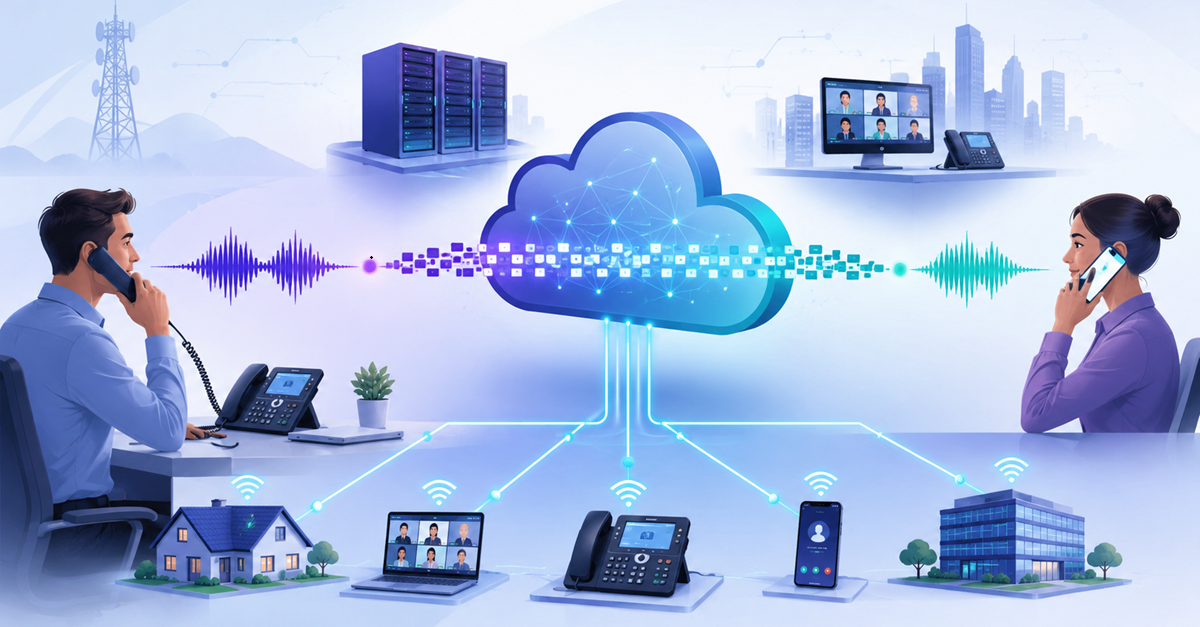
When you speak into a VoIP-enabled device, your voice is converted into digital data. That data is divided into small packets and transmitted across an IP network. Once the packets reach the recipient’s device, they are reassembled, decoded, and converted back into audible sound.
The process happens quickly enough for conversations to feel as natural as traditional phone calls.
Unlike conventional telephone networks that establish dedicated voice circuits, VoIP efficiently shares network resources with other types of internet traffic while maintaining real-time communication.
Why was VoIP developed?
Learning what is VoIP also means understanding why the telecommunications industry embraced it.
For decades, businesses relied on the Public Switched Telephone Network (PSTN). While highly reliable, expanding traditional telephone infrastructure required dedicated hardware, physical telephone lines, and significant operational costs.
As internet connectivity became faster and more reliable during the 1990s and early 2000s, engineers realized that voice could be transmitted using Internet Protocol, the same technology used to send emails, browse websites, and transfer files.
This innovation dramatically reduced the cost of long-distance communication while opening the door to entirely new calling and collaboration services.
Today, VoIP has become a foundation of contemporary business telephony.
How does VoIP work?
After learning what is VoIP, many people want to understand what actually happens when they place a call.
The process begins when a user speaks into a microphone on a desk phone, smartphone, computer, or conference device. Specialized software digitizes and compresses the voice using an audio codec before transmitting it across the network.
The encoded voice is divided into small packets and transmitted across the IP network. Throughout the conversation, these packets continuously travel between participants.
Several communication protocols work together behind the scenes to make this possible. Some protocols establish and manage the call, while others transport the actual voice data across the network. We’ll explore these technologies in greater detail later in this series when we discuss SIP, RTP, and WebRTC.
From the user’s perspective, however, the experience remains remarkably familiar: dial a number, wait for the call to connect, and start talking.
What equipment do you need for VoIP?
VoIP has become so widespread because the technology works with many different devices.
A VoIP call can be made using dedicated IP desk phones, computers running softphone applications, smartphones, conference room systems, or even web browsers.
Instead of requiring a traditional telephone line, these devices simply need access to an IP network and a VoIP service provider or business phone system.
This flexibility allows employees to use the same business phone number whether they’re working in the office, at home, or traveling.
Different types of VoIP deployments
As organizations adopt digital communications, they can implement VoIP in several different ways.
Some businesses prefer an on-premises deployment, where the phone system operates from equipment installed within their own facilities. This provides maximum control over the infrastructure but also requires dedicated hardware, maintenance, and technical expertise.
Hosted VoIP shifts much of that responsibility to a service provider, reducing the need for organizations to manage complex telecommunications equipment themselves.
Cloud-based VoIP has become increasingly popular because it offers exceptional scalability. Organizations can add new users, locations, and services quickly without investing in large amounts of physical infrastructure.
The best deployment model depends on an organization’s size, regulatory requirements, technical resources, and long-term communication strategy.
Why businesses choose VoIP
Many companies search for answers to the question “What is VoIP?” when considering an upgrade to their communication systems.
One of the biggest advantages is flexibility. Employees can make and receive business calls from almost anywhere using internet-connected devices, making hybrid and remote work much easier to support.
VoIP also simplifies business growth. Adding new employees, opening additional offices, or expanding internationally often requires little more than updating software and user accounts rather than installing entirely new telephone infrastructure.
Modern VoIP platforms also integrate with customer relationship management (CRM) systems, collaboration tools, help desks, and productivity applications. These integrations allow organizations to automate workflows, improve customer service, and gain better visibility into communication activity.
Features that once required expensive telephone hardware, such as auto attendants, call recording, conferencing, analytics, presence, and mobile extensions, are now commonly included within VoIP platforms.
How does VoIP support AI?
Another reason VoIP remains such a relevant topic today is the rapid growth of artificial intelligence.
Modern AI-powered communication services rely heavily on VoIP because voice is transmitted as digital data. This allows AI systems to process calls in real time, generate transcripts, summarize conversations, detect customer sentiment, assist agents during calls, and even power intelligent voice assistants.
Without VoIP, many of today’s Voice AI capabilities would be significantly more difficult to implement.
As AI continues to transform telecommunications, VoIP serves as the digital foundation that makes these innovations possible.
Are there any challenges with VoIP?
Like every communications technology, VoIP performs best when supported by a well-designed network.
Because voice travels across IP networks, call quality depends on factors such as available bandwidth, latency, packet loss, and jitter. Poor network conditions can introduce delays or reduce audio clarity.
Organizations often address these challenges by implementing Quality of Service (QoS) policies that prioritize voice traffic over less time-sensitive applications. This helps maintain consistent call quality even when the network is busy.
Security also plays an important role. Since VoIP operates over data networks, organizations should protect communications using encryption, secure authentication, firewalls, and regular software updates. Technologies such as SRTP and DTLS, which we’ll cover later in this series, help secure voice and video communications.
Finally, businesses should ensure their VoIP provider supports emergency calling, number portability, and local telecommunications regulations in their region.
Does VoIP replace the traditional telephone network?
After learning what is VoIP, another common question is whether traditional telephone networks still matter.
In reality, today’s communications environment combines both technologies.
Many VoIP calls stay entirely within IP networks, especially inside organizations or between cloud services. However, when someone calls a number served by another carrier, including a landline or mobile number, the call often passes through gateways that connect VoIP systems with the Public Switched Telephone Network.
This interoperability allows businesses to modernize their communications while remaining connected to virtually anyone with a telephone number.
As telecom providers continue migrating toward all-IP infrastructure, the role of VoIP continues to expand across residential, business, and enterprise communications.
Why understanding VoIP still matters
Learning “What is VoIP?” is one of the most important steps toward understanding modern telecommunications.
Nearly every communication platform used today, including hosted PBX, Unified Communications, contact centers, video conferencing services, collaboration platforms, and Voice AI apps, depends on VoIP in some way. VoIP has transformed voice from a standalone telephone service into a flexible digital application that integrates with the rest of an organization’s technology ecosystem.
As we continue this series, we’ll build on these concepts by exploring SIP, the signaling protocol responsible for establishing, managing, and ending most VoIP calls. Once you understand what VoIP is, it becomes much easier to see how SIP, RTP, and the rest of the modern communications stack work together to deliver the seamless calling experience we now take for granted.


Leave a comment