
We created this new article series to explain telecommunications in plain English. Each article answers a common “What is…” question without unnecessary jargon. The goal is to help business owners, IT professionals, telecom engineers, and anyone curious about communications understand how modern phone systems work. We begin at the very foundation of telecommunications: What is PSTN?
Before we dive into the first topic, it’s worth taking a step back and explaining why we’ve chosen this approach. Why should anyone spend time learning about traditional telecommunications when the industry is being transformed by AI, cloud communications, and intelligent voice agents?
The answer is simple. Every major innovation in telecommunications builds on decades of engineering and industry standards. Voice AI, Unified Communications, SIP, VoIP, contact centers, and cloud PBXs all rely on technologies and concepts that came before them. By understanding those foundations, it becomes much easier to explore the technologies shaping the future of business communications.
What is PSTN?
If you’ve ever searched for “What is PSTN“, you’re asking about the technology that made global telephone communication possible long before the internet became part of everyday life. Even today, although cloud communications and Voice over IP (VoIP) are used everywhere, the Public Switched Telephone Network remains an essential part of the world’s communications infrastructure.
Exploring what is PSTN provides valuable context for nearly every communications technology used today. As you continue through this series, you’ll see how concepts like SIP, VoIP, Hosted PBX, DID numbers, and Unified Communications all evolved from the principles established by the PSTN.
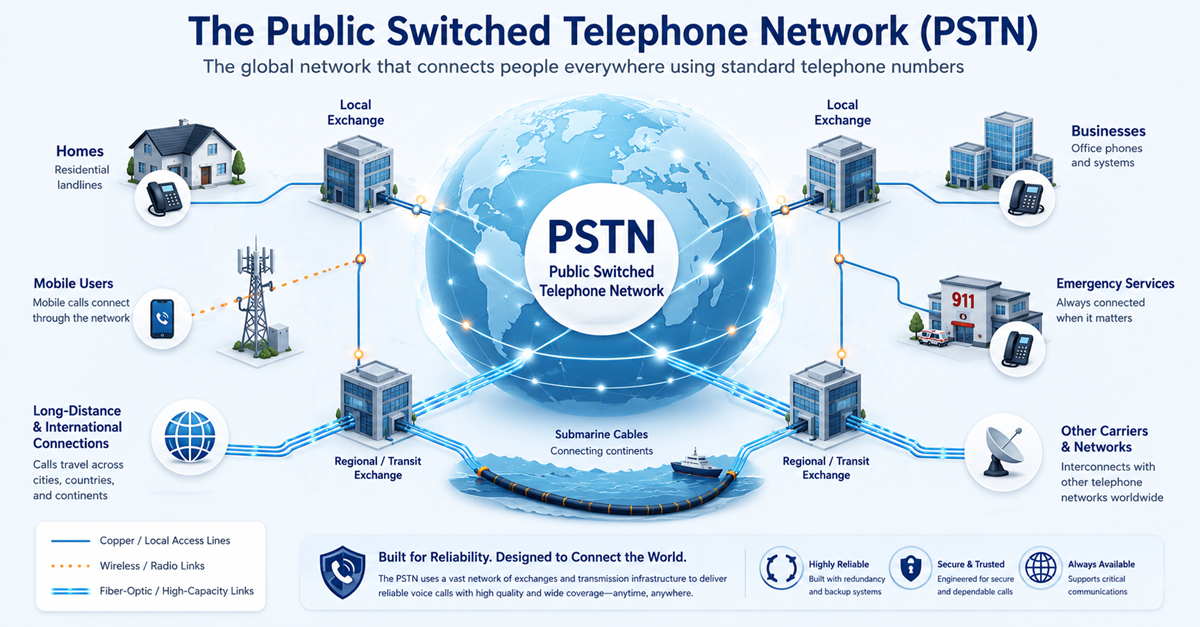
The Public Switched Telephone Network (PSTN) is the global network of interconnected public telephone systems that enables voice calls using standard telephone numbers. If you’re asking “What is PSTN?“, here’s what it is in simple terms. PSTN is the traditional telephone network connecting landlines, mobile carriers, and business phone systems around the world.
For more than a century, the PSTN has connected homes, businesses, government institutions, and emergency services across countries and continents. It is operated by telecommunications carriers that maintain the infrastructure required to route millions of phone calls every day.
Although many users now make calls through internet-based services, a significant number of those calls still interact with the PSTN at some point before reaching their destination.
A brief history of the PSTN
To fully understand what is PSTN, it helps to look at where it came from.
The first telephone systems appeared in the late 1800s after Alexander Graham Bell’s invention of the telephone. Early telephone networks required human operators to manually connect every call by inserting cables into switchboards.
As telephone adoption increased, manual switching became impractical. Electromechanical switching systems were introduced, allowing calls to be connected automatically. Over time, these evolved into digital exchanges capable of handling enormous call volumes with greater reliability.
Throughout the twentieth century, the PSTN expanded into one of the largest engineering projects ever undertaken. Millions of miles of copper and fiber-optic cables, submarine links, microwave networks, and satellite connections were deployed to create the global telephone system we know today.
While the technology inside the network has evolved considerably, the basic purpose remains unchanged: allowing people anywhere in the world to communicate using a telephone number.
How does the PSTN work?
The process begins when someone dials a telephone number. The local telephone exchange receives the call request and determines where the destination number is located. The call is then routed through a series of switching centers until it reaches the network serving the recipient.
Once the destination is identified, the network establishes the voice connection between both parties. During the conversation, voice travels through this path with very low delay and consistent quality. When either person hangs up, the connection is released so the network resources become available for another call.
The current PSTN infrastructure combines digital switching with fiber-optic transmission, making today’s network significantly more efficient than the analog systems used decades ago. Even so, the experience remains familiar: dial a number, wait for the call to connect, and start talking.
The main components of the PSTN
To better learn what is PSTN, it helps to recognize the main building blocks that make the network function.
Telephone exchanges act as the network’s traffic controllers, deciding how each call should be routed. Transmission infrastructure, including fiber-optic cables, copper lines, microwave links, and undersea cables, carries voice traffic across cities, countries, and continents. Local access lines connect subscribers to their service providers, while signaling systems coordinate call setup, routing, and termination behind the scenes.
These components work together continuously to deliver reliable voice communication, often without users realizing the complexity involved.
Why has the PSTN been so reliable?
One reason the PSTN has remained relevant for so long is its exceptional reliability.
Unlike many internet services that compete for bandwidth with other applications, traditional telephone networks were engineered specifically for voice communication. Carriers designed their infrastructure with extensive redundancy, backup power systems, and strict operational standards.
This level of engineering makes the PSTN particularly valuable for emergency services, hospitals, government organizations, financial institutions, and businesses where dependable communication is essential.
Even during natural disasters or local internet outages, parts of the PSTN often continue operating thanks to backup systems distributed throughout the network.
Does the PSTN still use analog technology?
Many people assume that it involves purely analog technology, but today’s reality is more interesting.
Historically, voice traveled over analog copper telephone lines directly from homes and businesses. Over the past several decades, however, telecommunications providers have modernized their networks extensively.
Today, much of the core PSTN infrastructure operates digitally. Fiber-optic transmission, digital switching equipment, and advanced signaling protocols handle the majority of long-distance communication. Analog technology often remains only in the final connection between some subscribers and their local telephone provider, although even that is gradually disappearing.
In other words, while the user experience may feel traditional, the technology inside the network has evolved significantly.
How does PSTN relate to VoIP?
As businesses adopt cloud communications, exploring what is PSTN also helps explain how Voice over Internet Protocol (VoIP) works.
VoIP allows voice conversations to travel over IP networks instead of dedicated telephone circuits. However, many VoIP calls still terminate on destinations reached through the PSTN. When that happens, service providers use gateways and SIP trunks to connect internet-based communications with the PSTN.
This interoperability allows someone using a cloud phone system to call a person using a traditional landline without noticing any difference in the conversation.
Rather than existing separately, today’s telecommunications often combine internet technologies with the traditional telephone network to provide seamless communication.
Is the PSTN going away?
As organizations continue migrating toward cloud-based communications, many people wonder whether the PSTN will eventually disappear.
Telecom providers in several countries have announced plans to retire portions of their legacy copper infrastructure. Instead, they are expanding fiber networks and IP-based services that offer greater flexibility and lower maintenance costs.
However, replacing a network that has been built over more than a century is a gradual process. Many businesses, government agencies, and residential users continue to depend on traditional telephone services. Furthermore, many cloud-based communication platforms still connect to the PSTN whenever calls are made to standard phone numbers.
For the foreseeable future, the PSTN will continue to play an important role within the broader communications ecosystem, even as internet-based technologies become increasingly dominant.
Why understanding PSTN still matters
Learning what is PSTN is about more than understanding an older technology. It provides the foundation for exploring nearly every communication system used today.
As this series continues, you’ll encounter technologies such as VoIP, SIP protocol, SIP Trunking, hosted PBX, Unified Communications, WebRTC, and Voice AI. Each of these innovations builds upon concepts that originated with traditional telephone networks.
Knowing how the PSTN works makes it easier to understand why contemporary communication systems are designed the way they are, how they connect with one another, and why telephone numbers remain such an important part of global communications.
Although the telecommunications industry is evolving rapidly with cloud services and artificial intelligence, the Public Switched Telephone Network continues to represent one of the most successful communication systems ever built.
Understanding what is PSTN is the perfect first step toward understanding the future of telecommunications. The next article in this series explores how voice moved from traditional telephone networks to the internet by answering another fundamental question: What is VoIP?


Leave a comment