
Welcome back to our limited series, Communications Then and Now. In the previous article, we explored SIP, the protocol that enables modern systems to establish and manage sessions over IP networks. SIP laid the foundation for modern real-time communication by making telecommunication systems flexible, scalable, and software-driven.
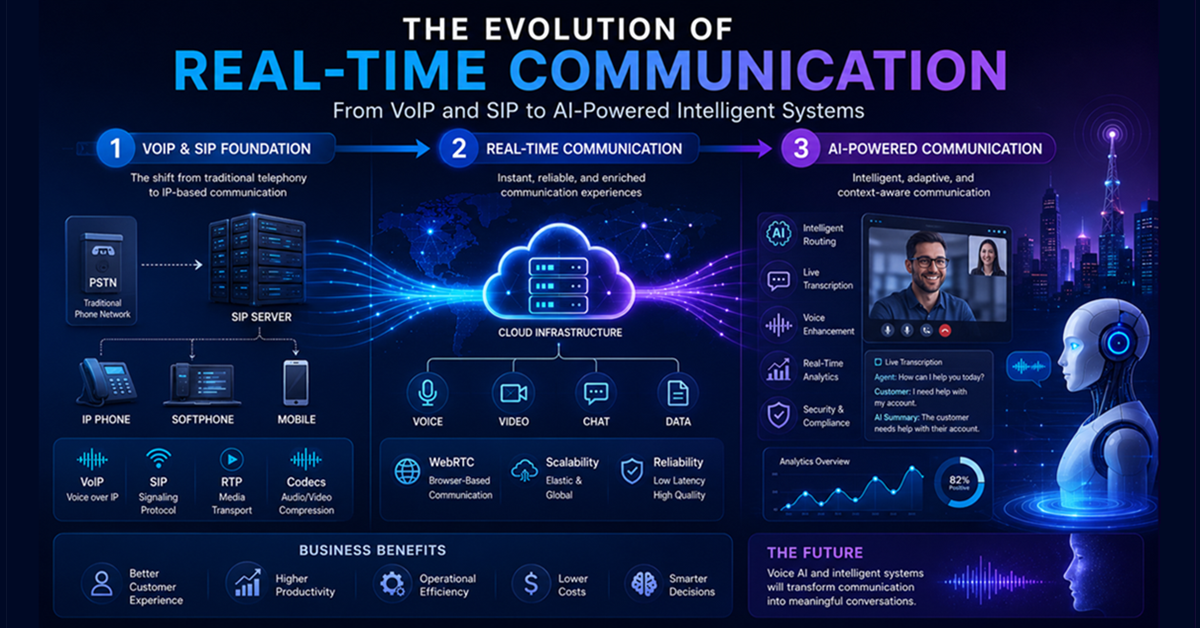
Once communication moved to IP networks, however, an entirely new wave of innovation became possible. Communication was no longer limited to simply connecting two endpoints. Systems could now process, analyze, and enhance interactions as they happened. This shift paved the way for real-time communication (RTC).
Built on technologies such as VoIP, SIP signaling protocols, and real-time media transport, RTC enables the instant exchange of voice, video, and data with minimal latency. It also introduces advanced capabilities such as intelligent routing, dynamic media processing, and integrated collaboration experiences.
As technology evolved, artificial intelligence (AI) also became part of the communication layer itself. Communication platforms transformed from passive infrastructure into intelligent, responsive systems capable of adapting in real time.
In this article, we explore how real-time communication evolved, how AI is enhancing such systems, and how intelligent platforms are redefining the way people connect, collaborate, and interact.
What is real-time communication?
Real-time communication (RTC) refers to the instant exchange of information between participants with little to no noticeable delay. Common examples include:
- Voice calls
- Video conferencing
- Instant messaging
- Live collaboration
- Multimedia streaming
Unlike traditional platforms, where delays were often expected or unavoidable, RTC systems prioritize immediacy, synchronization, and responsiveness.
This evolution became possible through the convergence of:
- VoIP technologies
- SIP signaling
- Cloud infrastructure
- High-speed internet
- Artificial intelligence
Together, these technologies transformed communication from a static service into a dynamic, intelligent experience.
The evolution from VoIP to RTC
VoIP fundamentally changed telecommunications by replacing circuit-switched PSTN infrastructure with packet-switched IP networks. This transition introduced major advantages:
- Lower operational costs
- Improved scalability
- Flexible deployment models
- Support for multimedia communication
However, the true transformation occurred when the communication platforms became capable of operating and adapting in real time. Instead of simply transmitting voice, they could now:
- Process live media streams
- Analyze conversations dynamically
- Optimize communication quality continuously
- Integrate with business applications and workflows
This transition introduced modern real-time communication ecosystems.
Core technologies
Real-time communication relies on multiple interconnected technologies.
VoIP
VoIP (Voice over Internet Protocol) remains the foundation for transmitting voice over IP networks. It enables services to operate independently of traditional telephone infrastructure.
SIP
SIP (Session Initiation Protocol) is a signaling protocol widely used in VoIP and real-time communication environments. It manages the signaling layer of communication:
- Session initiation
- Routing
- Session management
- Termination
Without SIP, modern real-time communication platforms would lack the flexibility required for dynamic communication.
RTP and media processing
RTP (Real-time Transport Protocol) enables the real-time transport of synchronized audio and video streams between endpoints.
WebRTC
WebRTC further accelerated the adoption of RTC by enabling browser-based voice, video, and data communication without requiring dedicated client applications.
Cloud infrastructure
Cloud-native communication platforms enable:
- Elastic scalability
- Distributed deployment
- Global service delivery
- Centralized management
Cloud-based Unified Communications platforms such as VoipNow integrate SIP, VoIP, and real-time collaboration services into a unified environment capable of supporting distributed teams and service provider deployments.
Artificial intelligence in RTC platforms
Artificial intelligence has become one of the most transformative elements of modern communication systems. AI no longer operates only as a back-end analytical tool. It now actively participates in real-time communication workflows.
Speech-to-Text and Text-to-Speech
AI-powered speech technologies enable:
- Real-time transcription
- Voice synthesis
- Accessibility enhancements
- Automated interaction systems
Speech-to-Text (STT) converts spoken language into text instantly, while Text-to-Speech (TTS) generates natural-sounding speech from written input. These technologies improve usability, accessibility, and automation across communication platforms.
Intelligent audio processing
AI can also improve communication quality dynamically by:
- Reducing background noise
- Enhancing voice clarity
- Detecting speech patterns
- Optimizing audio streams in real time
This became especially important with the rise of remote and hybrid work environments.
AI-driven analytics
Modern communication environments generate large amounts of operational and conversational data. AI enables platforms to analyze this data in real time to:
- Detect or predict network congestion
- Optimize routing
- Detect anomalies
- Improve user experience
This transforms modern platforms into intelligent systems capable of continuous optimization.
Real-time communication and user experience
One of the most significant outcomes of RTC evolution is the improvement of user experience. Modern users now expect:
- Instant connectivity
- Seamless transitions between devices
- Low latency
- Integrated collaboration tools
Real-time systems now support:
- Voice and video conferencing
- Screen sharing
- Team messaging
- Mobile collaboration
- CRM and business application integrations
Advanced platforms like VoipNow further add voice AI capabilities, delivering a centralized Unified Communications environment powered by AI.
Security and data privacy
As communication systems become increasingly interconnected and data-driven, security is critical. Real-time communication platforms must protect:
- Voice streams
- Signaling traffic
- User identities
- Sensitive business data
Key security mechanisms include:
- Encryption protocols
- Authentication systems
- Session Border Controllers (SBCs)
- Network monitoring and anomaly detection
At the same time, AI introduces new considerations regarding:
- Data privacy
- Regulatory compliance
- Ethical use of conversational data
Organizations must balance innovation with strong governance and security practices.
From communication platforms to intelligent systems
The evolution of real-time communication is changing the role of communication platforms themselves. Traditional systems focused primarily on connectivity. Modern platforms are increasingly designed around:
- Context awareness
- Automation
- Intelligent interaction
- Predictive assistance
This shift moves communication systems closer to becoming active participants in conversations rather than passive infrastructure.
Transition to the next stage
Real-time communication introduced intelligence into the communication layer. It enabled systems to process, analyze, and optimize interactions as they happen.
But the next stage of evolution goes even further. Instead of simply enhancing communication, emerging technologies are beginning to actively participate in it.
This is where Voice AI enters the picture.
Voice AI combines real-time communication, artificial intelligence, natural language processing, and generative models to create systems capable of understanding intent, responding conversationally, and interacting autonomously. In other words, modern platforms are evolving from communication tools into intelligent conversational systems.
➡️ In the next article of this series, we explore how Voice AI is redefining the future of communication.


Leave a comment