
From manual switchboards and on-premises PBX hardware to VoIP and cloud communications, business telephony has changed dramatically over the past century. This series follows that evolution one technology at a time. After covering the PSTN, VoIP, SIP, SIP trunks, and DID numbers, we have reached the platform that brings many of those elements together. The next step is understanding what a hosted PBX is and how it brings many of these technologies together into a complete business phone system.
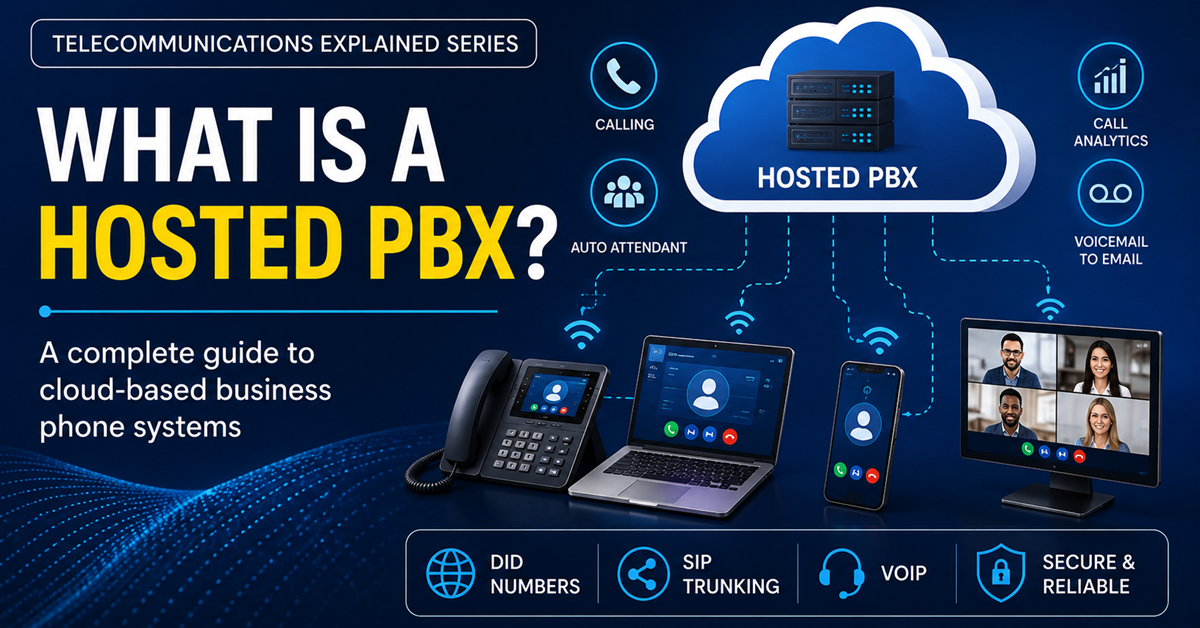
A hosted PBX is a business phone system whose core call-control functions, such as extension management, call routing, voicemail, and business-hour rules, run on infrastructure operated by a service provider rather than on PBX hardware maintained by the customer. In this article, we explain how it works, how it differs from an on-premises IP PBX, and what businesses should consider before choosing a provider.
What is a hosted PBX?
To understand what a hosted PBX is, it helps to start with the original PBX, which stands for Private Branch Exchange. Traditionally, a PBX was a telephone system installed at a company’s premises to manage calls between employees and connect them to the public telephone network.
A hosted PBX places the core call-control functions, such as extension management, call routing, voicemail, and business-hour rules, on infrastructure operated by a service provider. Users connect to the service through IP networks, while the provider manages the platform, infrastructure, maintenance, and software updates.
The result is a business phone system that can serve employees across offices, homes, and other locations without the organization operating its own PBX hardware on site.
Where did the PBX come from?
In the early days of business telephony, organizations needed a way to connect many employees without purchasing a separate external telephone line for every desk. Private telephone exchanges solved this problem by allowing employees to call one another internally while sharing connections to the public telephone network.
Early systems relied heavily on manual operators. Eventually, automated switching equipment took over, and the PBX became a familiar piece of equipment in business offices.
Traditional PBX systems could be substantial investments. Companies purchased switching hardware, installed telephone wiring, configured extensions, connected external trunks, and relied on specialized technicians to maintain the equipment.
Then voice began moving onto IP networks. The emergence of VoIP led to the IP PBX, which applied the familiar PBX model to IP communications. As broadband connectivity, virtualization, and cloud computing matured, service providers could host the PBX platform themselves and deliver business telephony as a service.
That evolution gave rise to the hosted PBX.
How does a hosted PBX work?
Another important part of understanding a hosted PBX is knowing what happens when someone makes a call.
Imagine Alice wants to call Bob, who works for the same company. Alice dials Bob’s extension. Her IP phone or application communicates with the hosted phone system, which determines where Bob is registered and routes the call to his device.
Now imagine Alice calls a customer outside the company. The provider’s platform applies the relevant routing rules and sends the call toward the destination using SIP-based connectivity and, where required, interconnections or gateways to external telephone networks.
Inbound calls follow a similar process. When a customer dials a company’s DID number, the provider receives the call and applies the routing rules. It might ring a particular employee, send the caller to an auto attendant, place them in a queue, or direct them to voicemail. All of these decisions are controlled by routing rules within the phone system.
How does hosted PBX work with VoIP, SIP, and DID numbers?
These technologies work together in a hosted PBX environment.
VoIP provides the technology for transmitting voice over IP networks. SIP is widely used to establish and manage communication sessions. SIP trunks can provide connectivity between communications systems and telecommunications providers. DID numbers give external callers a public phone number through which they can reach specific destinations.
The PBX manages the business logic around those communications. It knows that extension 201 belongs to Alice, for example, and that a particular DID should reach the sales department. It can determine whether an unanswered call should go to voicemail or whether calls arriving outside business hours should follow a different route.
When people ask about a hosted PBX, they are therefore asking about the platform that coordinates many of the technologies and rules behind everyday business calling.
Hosted PBX vs. on-premises IP PBX
The distinction between a hosted PBX and an on-premises IP PBX mainly concerns where the platform operates and who manages it.
With an on-premises IP PBX, the organization typically runs the core phone system within its own infrastructure. Its team takes responsibility for areas such as deployment, maintenance, upgrades, capacity planning, and availability.
With a hosted PBX, the service provider operates the core platform. The customer manages its users, numbers, devices, and communication preferences through administrative tools provided with the service.
Both approaches can use VoIP and SIP. The appropriate model depends on factors such as company size, existing infrastructure, internal expertise, regulatory requirements, customization needs, and business strategy.
Why do businesses use a hosted PBX?
One reason hosted PBX has become increasingly common is the flexibility it offers businesses.
A hosted PBX can reduce the amount of dedicated telephone infrastructure an organization needs to operate itself. Software upgrades, platform maintenance, and much of the underlying infrastructure management can become the responsibility of the provider.
Scalability is another advantage. When a company hires new employees, administrators can often create new users and extensions without installing additional PBX hardware. If the company opens another location, that office may be able to connect to the same hosted PBX rather than deploying a completely independent phone system.
This makes the model particularly useful for growing and geographically distributed organizations.
Hosted PBX and remote work
Remote and hybrid work have made this type of business phone system even more relevant.
In a traditional office-centric phone environment, a business extension was often closely associated with a physical desk phone. Hosted communications allow that identity to follow the user across supported devices and locations.
An employee might answer their business number from an IP phone in the office, a softphone on a laptop at home, or an application on a mobile device. Depending on the platform, several devices may even be associated with the same user.
This gives businesses a way to maintain consistent phone numbers, extensions, routing rules, and communication policies across a distributed workforce.
What features can a hosted PBX provide?
The exact functionality depends on the provider, but a modern hosted PBX can provide much more than basic inbound and outbound calling.
Common capabilities include call transfer, forwarding, voicemail, conferencing, call recording, business-hour routing, ring groups, call queues, auto attendants, and Interactive Voice Response (IVR).
Many platforms also provide web-based administration and user portals, allowing businesses to manage extensions, phone numbers, permissions, routing rules, and other settings without accessing physical PBX hardware.
Some hosted PBX platforms have expanded further into messaging, presence, video calls, screen sharing, mobile applications, and integrations with business software.
These capabilities can overlap with Unified Communications platforms, a subject we’ll explore later in this series.
What about reliability?
When evaluating a hosted PBX, reliability deserves careful consideration because the business is entrusting an external platform with an important communication service.
A well-designed hosted PBX service may use redundant components, geographically distributed infrastructure, proactive monitoring, backups, and failover mechanisms to reduce the risk of disruption.
However, the customer’s connectivity matters too. If users depend on an IP connection to reach the hosted PBX, problems with the local network or internet connection can affect service. Businesses with critical communications requirements may therefore use redundant internet connections, backup power, alternative routing, and mobile connectivity as part of their continuity strategy.
The provider’s architecture and operational history should also be evaluated carefully.
Is a hosted PBX secure?
Security is another important consideration when choosing this kind of business phone system.
Because modern PBX services operate over IP networks, they need protection against threats such as unauthorized access, account compromise, toll fraud, interception, and denial-of-service attacks.
Security can involve several layers, including strong authentication, access controls, encryption, network protection, monitoring, and fraud detection.
When supported and properly configured, TLS can encrypt SIP signaling, while SRTP can encrypt voice media in transit. Providers may also use Session Border Controllers and other network security mechanisms to control communication between different environments.
Businesses should examine how a potential provider protects customer data and communications, manages vulnerabilities, handles incidents, and complies with applicable regulatory requirements.
How to choose a hosted PBX provider
Understanding what a hosted PBX is represents only the first step. Businesses also need to determine whether a particular service can support their requirements.
Reliability should be high on the list. Organizations should understand the provider’s infrastructure, redundancy, service availability commitments, disaster recovery approach, and technical support.
Interoperability matters as well. A business may need specific desk phones, softphones, SIP services, CRM integrations, contact center applications, or other communications tools.
Pricing should be evaluated in context rather than simply comparing monthly subscription fees. Businesses should understand what is included, how phone numbers and calling are charged, whether advanced features cost extra, and how pricing changes as the organization grows.
Security, geographic coverage, emergency calling capabilities, number portability, regulatory compliance, and customer support are also important factors.
Hosted PBX and the move toward Unified Communications
Another reason this platform matters is that it represents an important stage in the evolution of business communications.
Once the PBX became software and moved into hosted infrastructure, providers could integrate telephony much more closely with other communication tools. Hosted platforms can combine voice with video meetings, instant messaging, presence, file sharing, mobile applications, and collaboration features within the same environment.
This evolution contributed to the growth of Unified Communications (UC) and Unified Communications as a Service (UCaaS), where multiple communication channels can be delivered through an integrated platform.
Hosted PBX therefore helped move business telephony from a piece of office equipment toward a software service accessible from almost anywhere.
Hosted PBX in the age of Voice AI
Artificial intelligence is pushing that evolution even further with Voice AI.
When thinking about a hosted PBX today, it’s worth considering that phone systems may increasingly connect calls to software agents as well as people. An incoming call could reach an employee, but it could also be routed to an AI receptionist or voice agent capable of understanding natural language. AI can assist with transcription, summaries, call analysis, routing, customer service, and other communication workflows.
The hosted PBX can provide the telephony environment around those interactions: phone numbers, extensions, routing rules, connectivity, and call control.
This illustrates a recurring theme throughout our series. AI may be changing what happens during a telephone conversation, while technologies developed over decades still help establish, route, and deliver the call.
Why understanding hosted PBX matters
Understanding this cloud phone system model brings us to an important point in the history of telecommunications.
The PSTN created the global telephone network. VoIP moved voice onto IP networks. SIP provided a way to establish and manage sessions. SIP trunks connected business communications systems with service providers, and DID numbers gave callers a way to reach specific destinations.
The hosted PBX brings many of these capabilities together into a business phone system delivered as a service.
From here, we can start exploring what happens once a call enters that system. How does a company greet callers and direct them to the right destination without requiring a receptionist to answer every call?
That question leads us to the next article in the series: What is an auto attendant?


Leave a comment