
Maintaining focus can be increasingly difficult in this hyper-connected world. With constant distractions from technology, work, and personal responsibilities, finding the ability to concentrate on tasks can feel like an uphill battle.
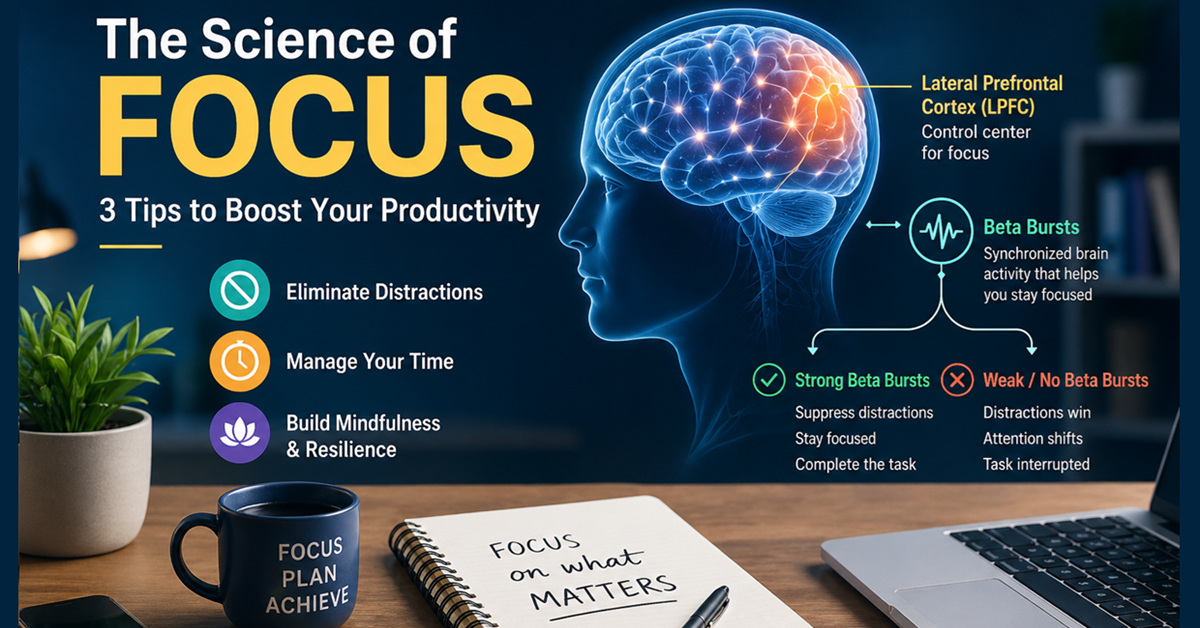
However, mastering focus is essential for improving productivity and making the most of our limited time. In this month’s installment of The Productivity Box series, we will explore three tips to help you enhance your focus and boost your productivity.
Understanding the importance of focus
Focus is the ability to direct our attention and energy towards a specific task or goal while ignoring distractions. When we are focused, our minds are fully engaged, increasing our efficiency and effectiveness.
Developing a strong sense of focus requires practice and discipline. By incorporating techniques such as time blocking, setting specific goals, and minimizing multitasking, individuals can enhance their ability to concentrate on the task at hand. Furthermore, mindfulness practices, such as meditation and deep breathing exercises, have been shown to improve focus by calming the mind and reducing mental clutter.
The role of focus in productivity
Focus plays a crucial role in productivity. When we are focused, we can complete tasks more quickly and with better quality. We become more efficient at problem-solving and decision-making. This enables us to achieve our goals in a shorter amount of time.
Maintaining focus not only impacts individual productivity, but also contributes to the overall success of teams and organizations. By fostering a culture that values concentration and minimizes distractions, companies can create an environment where employees can perform at their best. Collaborative efforts are enhanced when team members are able to focus on their respective roles and contribute effectively towards shared objectives.
The science behind
Research conducted by a team of neuroscientists (Source: Penn Medicine, 2023) shows that focus is driven by specific brain circuits involved in attention control, particularly in the lateral prefrontal cortex, which helps prioritize goals over distractions. These mechanisms are closely linked to executive functions such as attention control, working memory, and cognitive flexibility, which support efficient and goal-directed behavior.
To better understand this mechanism, here’s a simplified visual representation:
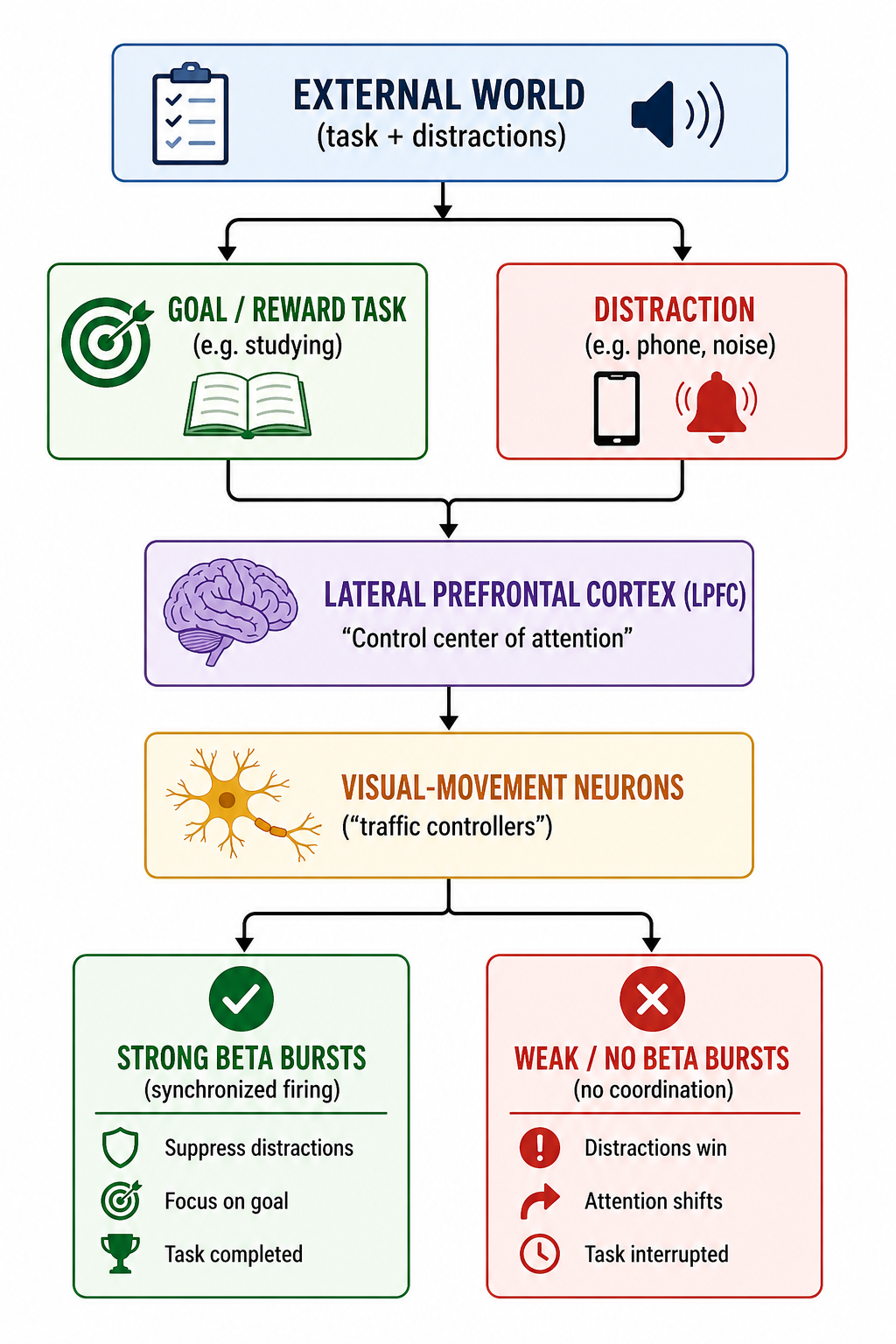
In essence, your brain manages attention by filtering what deserves focus. Everything starts with the external world, where both a meaningful task (like studying) and potential distractions (like noise or your phone) compete for your attention. These inputs are processed in the lateral prefrontal cortex (LPFC), which is the brain’s control center for focus.
From there, specialized visual-movement neurons act like decision-makers, determining whether your attention stays on the goal or gets pulled away.
The outcome depends on something called beta bursts, which are brief, synchronized bursts of activity that prepare the brain for focus. When these bursts are strong, your brain suppresses distractions, keeps you focused, and helps you follow through on your task. When they are weak or absent, distractions take over, your attention shifts and progress is interrupted.
In short, focus isn’t merely a question of willpower. It relies on a specific brain signal that determines whether you stay on track or get sidetracked.
While the study explains how focus works moment-to-moment, long-term improvements rely on neuroplasticity, the brain’s ability to reorganize itself by forming new neural connections. This plays a significant role in improving focus and efficiency. By engaging in activities that challenge the brain, such as learning a new skill or solving complex puzzles, individuals can enhance their cognitive functions and improve overall focus. Additionally, maintaining a healthy lifestyle through proper nutrition, regular exercise, and sufficient sleep is crucial for supporting optimal brain function and sustaining long-term focus and productivity.
Understanding how focus works is only the first step. The next step is applying this knowledge in your daily routine. Here are three practical ways to do that.
Tip 1: Creating a distraction-free environment
One of the most effective ways to sustain attention is by creating a distraction-free environment.
The impact of distractions on focus
Distractions are the biggest enemies of focus. They divert our attention and make it challenging to stay on task. Common distractions include phone notifications, social media, and noisy environments.
When we switch our focus, it can take over 20 minutes to fully regain deep focus according to research (Source: Dr. Gloria Mark at UC Irvine, 2008). Therefore, beyond workflow disruption, such interruptions significantly impact our cognitive processes.
Strategies for minimizing distractions
To minimize distractions, start by turning off notifications on your phone and computer. Find a quiet space where you can work without interruptions. If necessary, use earplugs or noise-cancelling headphones to block out external noise.
Another effective strategy is to create visual cues in your workspace that signal to your brain that it’s time to focus. This could be as simple as having a designated work area with minimal clutter, or using a specific color scheme that helps promote concentration.
Tip 2: Implementing time management techniques
Time management is a crucial skill that can significantly impact your productivity and overall well-being. By effectively managing your time, you can reduce stress, increase efficiency, and achieve your goals more effectively.
The Pomodoro technique
The Pomodoro technique is a popular time management method that involves working in short, focused bursts followed by short breaks. This technique is based on the idea that breaking down your work into manageable chunks can help you maintain high levels of focus without feeling overwhelmed. By setting a timer for a specific period (usually 25 minutes) to work on a task, followed by a short break, you can improve your concentration and productivity.
During each Pomodoro session, it’s essential to eliminate distractions and fully immerse yourself in the task at hand. By focusing solely on the task for a short period, you can make significant progress and maintain your motivation throughout the day.
The Eisenhower Box for task prioritization
The Eisenhower Box is a decision-making tool that helps you prioritize tasks based on their importance and urgency. This technique, popularized by former U.S. President Dwight D. Eisenhower, categorizes tasks into four quadrants:
- Urgent and important
- Important but not urgent
- Urgent but not important
- Not urgent or important
Use this method to gain clarity on which tasks require immediate attention and which can be scheduled for later. This approach allows you to focus your energy on the most critical tasks that align with your goals and values, while also identifying tasks that can be delegated or eliminated to reduce overwhelm.
Tip 3: Cultivating mindfulness and mental resilience
Mindfulness and mental resilience are powerful tools for improving and maintaining focus.
The power of mindfulness
Mindfulness involves paying attention to the present moment without judgment. By practicing mindfulness techniques such as meditation and deep breathing, you can train your mind to stay focused and avoid becoming overwhelmed by distractions.
Mindfulness improves emotional regulation and reduces stress, helping you stay centered and make clearer decisions. This heightened awareness of your thoughts and feelings can also enhance self-awareness and improve decision-making skills. Ultimately, it helps you stay focused and make better decisions under pressure.
Building mental resilience
Mental resilience is the ability to bounce back from setbacks and maintain focus during challenging times. Building mental resilience involves developing positive habits, setting realistic goals, and cultivating a growth mindset.
You can strengthen your mental resilience through regular practice of self-care activities such as exercise, adequate sleep, and social connections. These activities not only promote overall well-being but also provide a solid foundation for maintaining focus and productivity in the face of adversity.
Maintaining focus for long-term productivity
Finally, it’s essential to establish habits that support long-term focus and productivity.
When it comes to maintaining focus for long-term productivity, it’s important to work smarter, not harder. One effective strategy is to break down your tasks into smaller, more manageable chunks. By tackling tasks in smaller increments, you can maintain your focus and avoid feeling overwhelmed.
Contrary to popular belief, taking regular breaks can actually enhance focus and productivity. Our brains need rest to perform at their best. Incorporate short breaks into your workday to recharge and avoid burnout. During these breaks, engage in activities that help clear your mind, such as going for a short walk, practicing deep breathing exercises, or simply enjoying a healthy snack. These activities can rejuvenate your focus and energy levels, allowing you to return to your tasks with renewed vigor.
The importance of consistency and routine in mastering focus
Consistency and routine are key to maintaining focus and maximizing productivity. Create a daily schedule that includes dedicated focus time and stick to it. Over time, your mind will become accustomed to these routines, and focus will become natural.
Furthermore, consider incorporating mindfulness practices into your daily routine to enhance your focus.
Remember, it takes practice and dedication, but the results are well worth it. Start small, stay consistent, and you’ll start to notice in how you work, think, and manage your attention.


Leave a comment