
If you want to learn how not to implement collaboration software, here’s the perfect hypothetical situation: a mid-sized company is looking to enhance the knowledge sharing and productivity of its employees. As a result, the firm settles on a collaboration solution and the IT department has the task to implement the platform.
Posts Tagged Under: UC
Imagine this scenario: a lawyer and a client, separated by thousands of miles, need to decide if they’re going to accept a settlement by the 5 p.m. deadline. They planned on connecting over the phone at 4 p.m. to come to a decision, but the client is too busy with another meeting. Thankfully, with the help of Unified Communications, they are able to connect via instant messaging and discuss the settlement (without having to leave the meeting), reaching a decision before the deadline passes.

The highly experienced but less tech-savvy baby boomer generation has been dominating the global workforce for some time now, but that’s about to change. Before you know it, the soon-to-retire boomers will be replaced by the ambitious, technologically savvy and collaborative millennials, who don’t remember a time without computers and smartphones. Growing up with laptops, Wi-Fi, 3G and social media, the digital world circulates through their system as they expect immediate access to information at all hours of the day.

We have just released VoipNow 3.5 Beta. It’s been a long journey, but the first beta of the new version is finally here, better than ever.
It contains over 80 core improvements designed to help you win the SMB market such as upgraded architecture, improved UI, better PBX with support for WebRTC, call encryption, and a lot of other enhancements that simplify the operation of large deployments. It also comes with over 100 bug fixes, most of them related to the updated architecture.
The banking sector has been through a lot for the past 6 years. Starting with the 2008 financial meltdown and continuing with a perpetual lack of customer trust, the banking industry seemed to be on a continuous downward spiral.
Yet, there are signs that banks have finally learned their lessons and have managed to turnaround consumers’ confidence. The 2014 Ernst & Young Global Consumer Banking Survey shows that consumer confidence in banks has risen 50% versus previous year. The report goes on to state that this increase is not the result of consumers turning back to “normal” but rather the result of banks taking an active stance on building trust again. And this trust resides on customer experience.

Last year, Yahoo CEO Marissa Mayer made the headlines when she announced that her employees would no longer be able to work from home. Some industry pundits speculated as to whether that meant the end of remote jobs. A few months later however, Dell CEO Michael Dell announced his intention to enable half of his 14,000 workforce to work from home. At the time of his announcement, 20 percent of his team were already working from home.
So, while the jury is still out whether Yahoo fares better or not, Dell’s decision merely expanded what already proved to be a good decision: in 2012, thanks to its remote working policy, the company saved $14 million—and 6,735 metric tons of carbon dioxide emissions. It seems that offices will soon be a thing of the past, or at least will need to be re-imagined, as more and more companies are shifting to flexible working policies.
With technology advancing so fast, it’s often a wonder that the process of delivering education is still a piece of the twentieth century. It’s true that the world of online universities and learning websites from Coursera to Kahn’s Academy and other MOOCs is taking off, but many traditional schools, high-schools and universities are still stuck with paperwork when it comes to collaboration, and to simple voice when it comes to communication. Education should be at the forefront of what tech has to offer.
Some schools are making inroads into how to leverage technology. For example, the North Carolina School of Science and Mathematics (NCSSM) provides interactive video courses for K-12 schools across North Carolina. Students from across the state can collaborate in project teams and class discussions. Meanwhile, NCSSM teachers monitor the class in real-time and assess student learning. Yet, such schools are the exception, not the norm. The 2011 CDW Unified Communications Tracking Poll found that only 17% of higher education has implemented some of the features that are part of Unified Communications.
For quite some time, VoIP telephony and Unified Communications tools (voice, instant messaging, video calls, audio conference, and presence combined into a single communication stream) have proliferated on many markets, and now it appears as though Africa too is on the brink of this communications revolution. With technology evolving so fast, businesses in developing areas of the world are catching on to the need to deploy robust communications tools.
By taking advantage of both VoIP and UC, companies benefit from cost savings and increased functionality which, in turn, improve business processes and boost productivity.
As the number of reliable Internet connections increases, so does the number of businesses that can leverage IP telephony. With that in mind, let’s take a look at two countries in particular—South Africa and Nigeria—and how VoIP and UC are making an impact there.
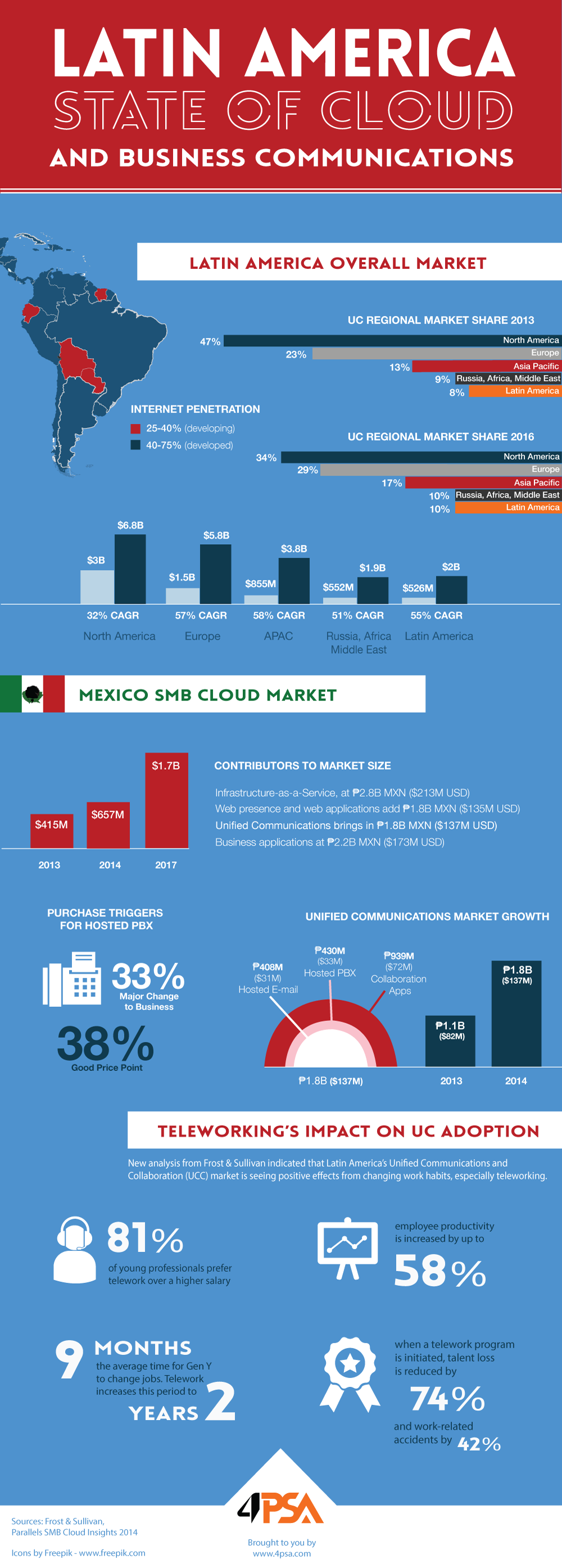
Last week we talked about how Unified Communications and Collaboration are shifting the way people work. This week it’s time to take a look at the state of cloud and business communications in Mexico.
An Ovum study conducted with over 1,300 ICT decision makers in 18 countries revealed that organizations are still bound to on-premises Unified Communications. Around 80% of UC systems are deployed on-premises and managed internally or by a third party. Managed UCC arose from the need of organizations lacking in-house experts to support the UC evolution. So where’s the cloud in all of this? If we look below, we can see that hosted core IP PBX stands at 3%, while instant messaging and presence lead the way with 7%; which is a lot less than we’d like.


