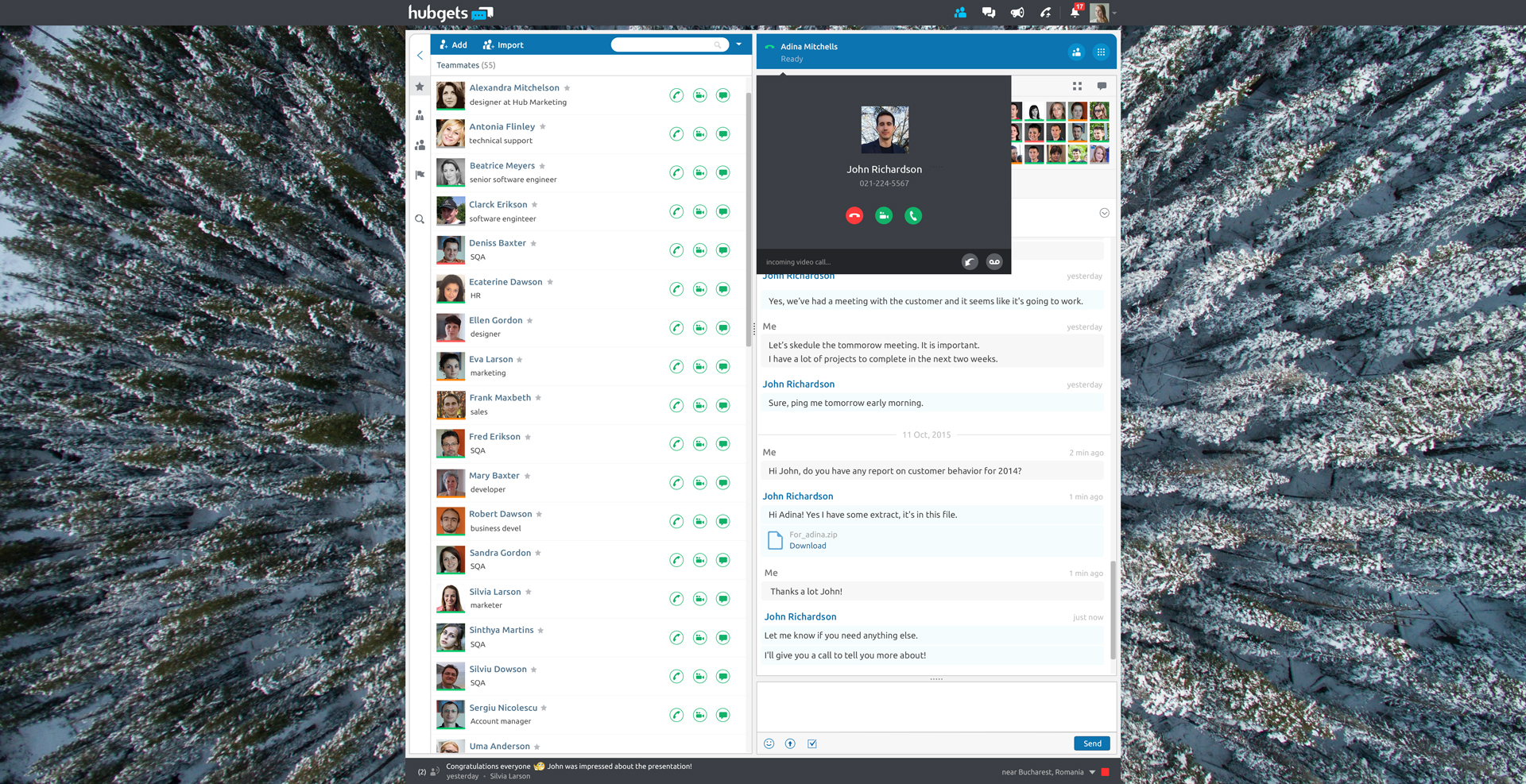
We developed Hubgets with the goal to make our teamwork as smooth as possible. Then, we shared it with the world. With Hubgets, you can have cohesive teams and a flexible work policy. You can reach people half way across the globe using the same mechanism you would to buzz a colleague 10 feet away. Today, we’ll look at the Phone component in Hubgets.
Posts Tagged Under: phone

Photo by Fezbot2000 on Unsplash
When speaker Ryan Jenkins was approached by an audience member saying that his Millennial workforce was much more comfortable with texting compared to phone calls, he took it as further evidence that this was indeed the case and identified five reasons why this might be.
To his credit, Jenkins dots the “i” with some of his observations. Chief among them is the presumptuous nature of the practice, which implies that you drop everything to pick up the phone, without any fair warning as to what the caller has to say and how it will affect your workflow, or for how long. But that’s where I draw the line regarding the negative side of voice calls. Characterizations like time consuming, distracting, superfluous, and ineffective are the product of a subjective analysis, even though none of these are false either

Photo by Quino Al on Unsplash
Not too long ago, when we called someone we used to keep our fingers crossed for them to be close by to pick up the phone. When cell phones hit the mainstream, reaching someone became easier, but calling them wasn’t cheap. So although people were more certain to hear each other, they didn’t do so considerably more often.
Then came the smartphone which forever changed the playground. Communication took on even more forms. Instant messaging was added to the mix, along with email on the go and video chatting. Today, voice calls are a lot cheaper, but according to numbers dished out by Nielsen, the traditional “hello” has neither increased, nor decreased in usage
Photo by rawpixel on Unsplash
Making sure you sound good over the phone is critical to building a good rapport with your clients. Whether you’re converting a lead into a buying customer or troubleshooting a technical issue, there are many techniques you can use to get the person on the other end of the line to really like you. Here are some of them.

Photo by Tiko Giorgadze on Unsplash
Have you ever asked yourself who made the first-ever phone call? Or what that conversation was all about? If so, look no further. Here’s how it all went down.
To get one thing out of the way, it was the very person who invented the first practical telephone that also made the first phone call. His name was Alexander Graham Bell, and he was one of the foremost visionaries of his time. A Scottish-born scientist, inventor, and engineer, Bell’s work was profoundly influenced by his mother’s deafness, which led him to study acoustics, and elocution (formal speaking in pronunciation, grammar, style, and tone).
Photo by rawpixel on Unsplash
The death of fixed phones is near. But there’s one place on the planet where this is more obvious than anywhere else: Africa. Landlines are almost nowhere to be found south of the Sahara desert, while cell phones are anything but scarce, according to the results of a Pew Research Center survey of seven African nations. But despite the cell phone’s increased popularity in Africa, far less people own a smartphone there than in the United States.
Photo by rawpixel on Unsplash
Cloud-connected phones offer massive benefits over fixed lines, but those advantages go beyond communication purposes. What if you could use biometric smartphones to spot Malaria, Cholera or Ebola before an outbreak.
When creating a new product or launching a new service, the first question you ask yourself is whether it will be successful and you will be able to sell it. Marketing theory says that you start with the user’s needs and then build products/services to meet them. In reality, after the launch it doesn’t work like that anymore. You already have your solution and want to find a way to match it on potential customers’ needs. As soon as you can sense any opportunity there, you can start building your approach.
In this first article of the series, we will start with medical practices. Imagine a medical partnership with a couple of practitioners and a couple of nurses in a small office, a receptionist, and a legacy telephony system.