
Voice AI is transforming how humans interact with machines, evolving from basic text-to-speech (TTS) systems to sophisticated neural networks capable of expressive, human-like communication. As speech synthesis becomes more natural and accessible, industries worldwide are reimagining customer service, education, healthcare, and creative content.

Today, voice AI powers everything from customer support bots and digital companions to immersive audio books and personalized media experiences. The global AI voice market is projected to grow from $21.75 billion in 2023 to over $50 billion by 2030 (Source: Grand View Research, 2023). This trend is fueled by breakthroughs in natural language processing (NLP) and the rising demand for virtual assistants.
In this article, we’ll explore the mechanics of AI voice, where it’s making the biggest impact, ethical challenges, and what its future could mean for communication, creativity, and human connection.
What is voice AI?
The AI voice technology generates or modifies human-like speech using machine learning models. These systems analyze vocal cues such as pitch, rhythm, and emotional inflection to produce speech indistinguishable from human voices. Tools like Alexa and Siri rely on AI voice to sound natural, even when no human is involved.
Modern voice AI generators use deep neural networks, including architectures like recurrent networks and transformers, to capture and reproduce the unique characteristics of a person’s voice. Research (Source: Nature Machine Intelligence, 2022) showed that models trained on thousands of hours of diverse speech data can replicate accents and emotions with up to 95 percent accuracy.
At the core of AI voice lies speech synthesis, the process of converting text or audio input into natural-sounding speech. This is achieved through deep learning algorithms that learn patterns in human speech and generate coherent, lifelike audio. A notable example is WaveNet developed by DeepMind in 2016, which uses a neural network to predict raw audio waveforms. It produces voices so natural they are nearly indistinguishable from real human speech.
How voice AI works
Creating an AI voice starts with teaching the system how people talk. To do that, it needs a lot of examples, usually hundreds of hours of recorded speech.
For instance, cloning a celebrity’s voice might involve analyzing more than 20 hours of their speech to capture unique patterns in tone, rhythm, and pronunciation (Source: ElevenLabs, 2022). Once trained, the AI converts text or new audio inputs into speech using techniques like waveform generation. Once the model learns these patterns, it can turn text or even other audio samples into realistic speech using advanced waveform generation techniques.
Creating an AI voice involves three stages:
- Data collection: High-quality audio recordings are gathered, often in soundproof or controlled environments to eliminate background noise and ensure clarity.
- Feature extraction: Algorithms analyze the recordings to identify vocal traits such as pitch, volume, rhythm, and intonation, namely the subtle nuances that make each voice distinctive.
- Synthesis: The AI then reconstructs speech by combining these learned features, generating smooth, coherent audio that sounds remarkably human.
This is the same technology that powers familiar voices like Alexa and Cortana, built using tools such as Amazon Polly and Microsoft Azure Cognitive Services.
Applications across industries
Business and customer service
Companies use AI voice assistants to reduce support costs and improve response times. American Express, for example, automates 80 percent of customer inquiries using AI voice bots, cutting resolution times by 30 percent (Source: Forbes, 2021).
The impact extends to marketing, too. Netflix is actively experimenting with AI to personalize how it promotes and localizes content, from dynamic trailers tailored to viewers’ tastes to AI‑assisted dubbing and voice recreation in select documentaries.
In e-commerce, AI voice assistants like Shopify’s Alpaca help customers browse products and make purchases via voice commands. A survey found that 64 percent of consumers prefer voice-driven shopping experiences for their speed and convenience (Source: PwC, 2023).
Healthcare and accessibility
AI voice technology is also improving healthcare accessibility. It helps patients with mobility or vision impairments by converting text into natural speech, making digital services more inclusive.
In telemedicine, AI voice assistants schedule appointments, explain treatments, and follow up with patients after visits. In Japan, Fujitsu’s AI voice system reminds elderly patients to take their medication and can alert caregivers if help is needed (Source: Fujitsu, 2022).
Education and learning
Beyond healthcare, education is another area seeing rapid adoption. In classrooms and online learning, AI voices make education more interactive and accessible. Duolingo, for example, uses AI-powered tutors that speak 38+ languages, helping over 500 million learners practice pronunciation and conversation (Source: Duolingo Impact Report, 2023).
AI voice tools are also empowering students with learning differences. For example, Co:Writer by Don Johnston turns typed text into spoken words, supporting students with dyslexia or speech disorders. Research shows that such tools can significantly improve literacy among learners with visual, physical, and cognitive disabilities (Source: Sustainable Future, 2025).
Telecommunications
The telecommunications sector is undergoing a major evolution driven by AI voice agents. These systems combine advanced speech synthesis with conversational intelligence to automate routine tasks, power virtual assistants, and enable effortless call routing. By adopting AI-driven voice technologies, service providers can significantly cut manual effort, enhance customer satisfaction, and deliver personalized service experiences at scale.
AI voice agents also empower telecoms’ business clients. Through lifelike speech synthesis and intelligent dialogue, enterprises can augment their workforce with virtual agents, streamline operations, personalize customer interactions, and achieve levels of efficiency that were once out of reach.
Find out how VoipNow can help you deliver voice agents to your customers today.
Entertainment and media
From movies to video games, AI voices are changing the creative process. In Cyberpunk 2077, developers used AI-generated dialogue for non-player characters (NPCs), saving time and production costs while keeping conversations dynamic (Source: CD Projekt Red, 2020).
In music and storytelling, tools like Amper Music use AI to produce custom vocals, while AI Dungeon creates interactive stories narrated by synthetic voices. This approach blends creativity and technology in entirely new ways.
Step-by-step guide on how to make an AI voice
There are four fundamental stages in the creation of an AI voice:
- Assess internal data readiness: Secure high-quality audio samples for model training.
- Evaluate platform compatibility: Ensure services (e.g., Azure, ElevenLabs) fit with current infrastructure.
- Plan for compliance: Align with GDPR/CCPA guidelines on voice data privacy.
- Pilot and scale: Start with small-scale deployments before full rollout.
It’s important to first analyze your current workflows and identify how voice AI can generate measurable ROI in areas like customer service, healthcare, and beyond.
Data collection and preparation
Every AI voice begins with data. Lots of it! To train a realistic model, you typically need 20-50 hours of high-quality audio (44.1 kHz, 16-bit WAV format) from a single speaker. Some platforms, like ElevenLabs, can clone a basic voice using as little as 15 minutes of audio, while more advanced models may need several hours to capture emotional range and natural variation in tone and accent.
Before training begins, the recordings go through preprocessing:
- Cleaning the audio
- Removing background noise
- Normalizing volume levels
Tools like Audacity or Adobe Audition are commonly used to refine recordings for consistency.
For example, Google’s Tacotron 2 was trained based on 24.6 hours of professionally recorded speech from a single professional female voice actor. Everything was carefully preprocessed to ensure smooth and natural results.
Training the AI model
Next, the AI model learns to speak. Using tools like Descript’s Voice AI or Google’s Tacotron 2, developers train neural networks to map written text to spoken words. During this phase, the system analyzes thousands of examples to understand how pitch, pacing, and pronunciation work together.
Research from 2023 found that transformer-based models can reach up to 98 percent accuracy in replicating a voice after about 100 hours of training.
The training process typically includes three steps:
- Data augmentation: Adding slight variations (like background noise or pitch shifts) to make the model more adaptable.
- Loss function optimization: Fine-tuning the model to reduce differences between generated and real speech.
- Validation: Testing performance on new, unseen data to ensure the voice sounds natural in different contexts.
An impressive example is OpenAI’s Whisper, which uses unsupervised learning, meaning it can train on unlabeled audio. This allows it to understand and generate speech in 92 languages without explicit instruction.
Customization and optimization
Once trained, the AI voice can be customized to fit different needs. Developers can tweak settings like pitch (raising or lowering by up to 12 semitones) and speed (from 0.5× to 2×). Tools such as Respeecher even let you change a voice’s age or gender, making it ideal for gaming, film, or content creation.
Finally, post-processing tools like Adobe Audition polish the final result. They help you smooth transitions, remove robotic tones, and enhance clarity. Advanced setups can even modulate emotion, giving the AI voice the ability to sound happy, sad, calm, or excited, depending on the context.
AI voice vs. traditional TTS
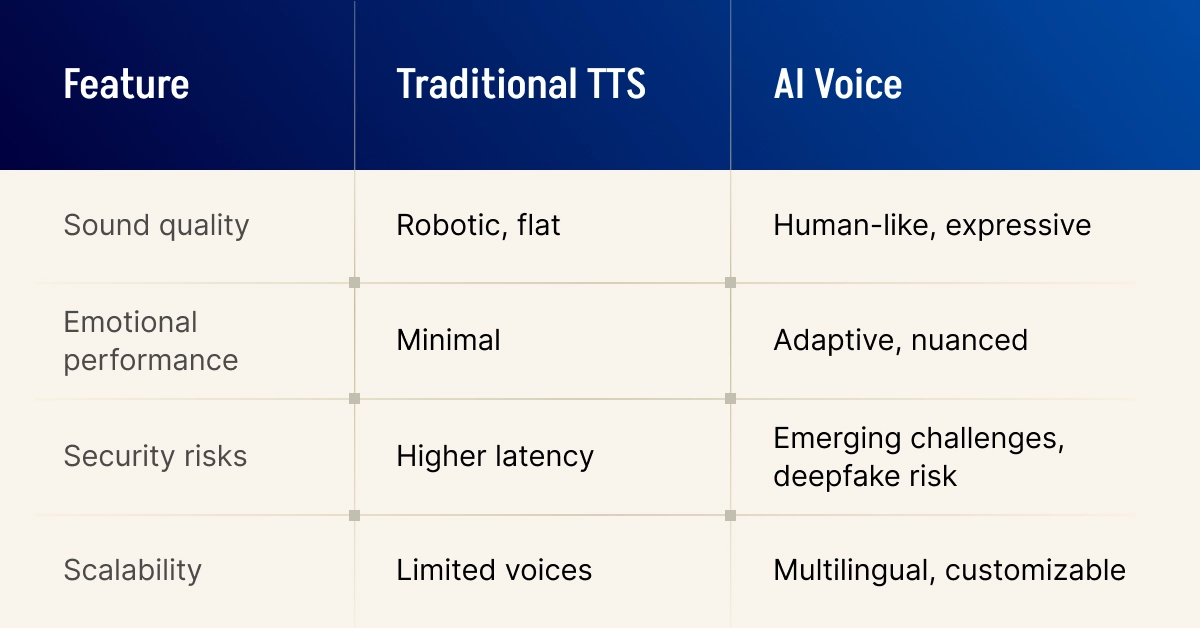
Traditional text-to-speech (TTS) gave machines a voice. Voice AI gives them personality.
From robotic to remarkably human
Traditional text-to-speech (TTS) systems laid the groundwork for digital voice technology, but their limitations are easy to spot. They rely on rule-based algorithms or stitched-together audio clips, producing voices that sound mechanical, flat, and emotionless. While functional, they can’t truly capture the nuance and warmth of natural human speech.
On the other hand, AI voice technology uses deep learning and neural synthesis models like WaveNet, Tacotron, and VITS. These systems learn from massive datasets to understand not just words, but how people speak, capturing rhythm, tone, and emotion. The result is speech that feels natural and expressive, much closer to real human voices.
Sound that connects
AI voices don’t just sound human. They can express emotion, ultimately feeling human. They can laugh, pause, emphasize, and adapt tone based on context. Whether it’s a friendly customer service agent, an engaging narrator, or a multilingual virtual assistant, AI voice technology creates genuine emotional connections that traditional TTS can’t match.
While older TTS systems still serve basic needs like public announcements, GPS navigation, or basic accessibility tools, they tend to sound flat and robotic. Traditional TTS lacks the personality and flexibility that modern users expect. AI voice delivers brand-consistent, emotionally resonant speech that enhances engagement and builds trust.
Latency and real-time interaction
Today’s AI voice solutions are optimized for real-time interaction. They enable smooth and natural conversations in live settings across any platform, such as virtual assistants, call centers, or gaming environments.
They’re also incredibly scalable. For instance, Amazon Polly now offers 100+ lifelike voices in over 47 languages, while ElevenLabs’ API allows developers to create and deploy custom voices in minutes. The result? Faster, more personal, and more immersive experiences.
Traditional TTS systems, by comparison, often have higher latency, namely slower response times. This makes them less effective for dynamic, back-and-forth communication.
Is voice AI safe? Ethical considerations
Privacy and consent
As AI voice technology advances, so do the conversations around privacy and data protection. Is voice AI safe? This is a legitimate concern considering that voice data is deeply personal. It carries not just words, but identity, emotion, and intent. That’s why collecting and processing voice recordings must be handled with transparency and consent.
Earlier this year, an AI company faced a class action lawsuit for allegedly recording private meetings and using those recordings to train its models without participants’ consent (Source: Gizmodo, 2025). Regulations like the EU’s GDPR and California’s CCPA are clear: voice data is private information, and companies must obtain explicit consent before using it.
Voice cloning introduces another layer of complexity. A 2023 report by Electronic Frontier Foundation (EFF) warned that synthetic voices could be misused for impersonation, scams, or disinformation campaigns. In one high-profile case, a UK startup was sued after allegedly cloning a CEO’s voice without authorization. This should serve as a reminder of how powerful, and potentially dangerous, this technology can be when misused.
Deepfakes and misinformation
AI-generated voices have opened the door to deepfake audio, where synthetic speech is used to deceive. In one infamous 2019 case, scammers cloned a CEO’s voice to trick an employee into wiring $243,000 to a fraudulent account.
To counter these threats, the industry is fighting back with innovation. Companies like Microsoft, through Azure AI, are deploying advanced voice authentication and anti-spoofing systems capable of detecting synthetic or manipulated audio in real time.
Building a responsible future
The promise of AI voice comes with responsibility. Ethical use, built on consent, transparency, and security, is key to earning public trust.
As the technology evolves, so must the safeguards around it. Forward-thinking organizations are already setting the standard by prioritizing responsible data practices and investing in detection tools that ensure AI voice remains a force for good, not deception.
The future of AI voice technology
The next generation of AI voice is ready to blur the line between machine and human communication.
Emerging research and breakthroughs in neural modeling suggest that future AI voices will not only speak naturally but also feel human, expressing genuine emotion, tone, and intent in real time.
Workforce augmented with AI agents
As AI voice technology advances, the future of work is shifting toward human-AI collaboration rather than replacement. Intelligent voice agents are emerging as indispensable team members, capable of handling high-volume, repetitive, or multilingual communication tasks while humans focus on empathy, strategy, and creativity.
Beyond direct customer interaction, voice agents also serve as virtual assistants and supervisors, helping teams perform better. They can provide real-time insights, surface key data during conversations, and even monitor compliance or service quality across thousands of interactions. By augmenting the workforce in this way, organizations achieve round-the-clock efficiency, consistency, and personalization at scale.
With VoipNow’s Voice Agent extensions, service providers can now deliver intelligent, AI-powered voice solutions that work alongside human teams to enhance productivity and improve customer experience. Find out more.
Emotionally intelligent voices
One of the most exciting frontiers is emotional synthesis, namely the ability for AI to understand and express emotion through speech. OpenAI’s EmoTTS project (Source: arXiv, 2024) introduced neural emotion coding, enabling text-to-speech systems to replicate complex feelings such as empathy, excitement, or calmness.
Imagine virtual assistants that sound truly caring or narrators that adapt their tone to match the story’s mood. This is where voice AI is headed.
Multilingual real-time communication
Real-time AI voice synthesis will also transform global communication. Technologies like NVIDIA’s Riva models already process and transcribe speech up to 100× faster than real time (Source: NVIDIA, 2023), paving the way for instant language translation and seamless cross-lingual collaboration.
Soon, a conversation between two people speaking different languages could feel as natural as chatting face-to-face.
Automation in entertainment and media
In the entertainment industry, AI is set to automate routine voiceover and dubbing work, freeing human talent to focus on creative and high-value performances.
Analysts predict a gradual shift rather than a full replacement with AI handling repetitive or localized tasks, while professional voice actors bringing depth, artistry, and personality to storytelling.
Transforming healthcare and senior care
AI voices are also finding a meaningful place in healthcare and eldercare. The World Health Organization (Source: WHO, 2022) highlights AI companions as valuable tools for supporting seniors by reminding them to take medication, providing company, or assisting with routine care.
Market reports forecast strong adoption of such solutions by 2030, as healthcare systems worldwide look for ways to improve quality of life and reduce costs through intelligent automation.
Reimagining education
Education is another area primed for transformation. According to UNESCO (2024), AI-driven tutoring systems outperform traditional methods by offering personalized, adaptive learning experiences. When combined with teacher guidance, they can:
- Boost engagement.
- Close learning gaps.
- Expand access to quality education.
These patterns have been observed especially in underfunded schools and developing regions.
Dynamic, emotion-driven gaming
The gaming world is rapidly embracing emotionally aware AI voices to create living, responsive worlds. Game engines like Unity are experimenting with NPCs whose voices and personalities adapt dynamically to player actions and emotions (Unity Technologies, 2023).
Academic research (Source: ACM, 2025) confirms that integrating neural networks, sentiment analysis, and natural language processing into games enables NPCs to mirror player moods and make story lines reactive and personalized.
Imagine a game where every conversation changes the plot not because it was scripted that way, but because the AI understood how you felt.
Embrace AI voice today
Voice AI is changing the way we communicate, helping people and businesses connect more naturally, efficiently, and creatively. From customer support and education to healthcare and entertainment, it’s unlocking new possibilities for accessibility, personalization, and global collaboration.
As the technology grows, so does our responsibility to use it wisely. Ethical practices and transparency will be essential to protect privacy, build trust, and make sure AI voice is used to enhance, not replace, human expression.
For businesses, creators, and developers, this is the perfect time to explore what AI voice can do. Whether you’re designing smarter assistants, creating content faster, or making products more inclusive, the tools available today make innovation more accessible than ever.
The future of AI voice has two goals, equally important: perfecting sound and making communication more human. As AI voices become more emotional, multilingual, and context-aware, they’ll shape the future of human-machine communication.
The next era of interaction has a voice and it’s ready to be heard. Is your organization prepared for the next step in human-machine communication?
This article was first published on 7 November 2025 and updated on 9 February 2026 after the launch of VoipNow 5.7 with AI voice agents integration and MCP servers.


2 Comments
You can post comments in this post.
L 6 months ago
“The impact extends to marketing, too. Netflix uses an AI voice system to produce over 2,000 unique trailer voiceovers per title, boosting viewer engagement by 15 percent (Source: Netflix Tech Blog, 2023).”
The linked article (https://netflixtechblog.com/building-in-video-search-936766f0017c) is entirely irrelevant to the claim made here… was this an AI hallucination or was the incorrect article linked unintentionally?
Blog wizard 6 months ago
Thank you for that, now both the link and the explanation are correct.
Leave a comment