
From the first telephone exchanges to today’s cloud platforms and AI voice agents, one thing has remained remarkably important in telecommunications: the phone number. Understanding what is a DID number is therefore an important step in understanding how modern phone systems connect callers with the right person, department, application, or AI service.
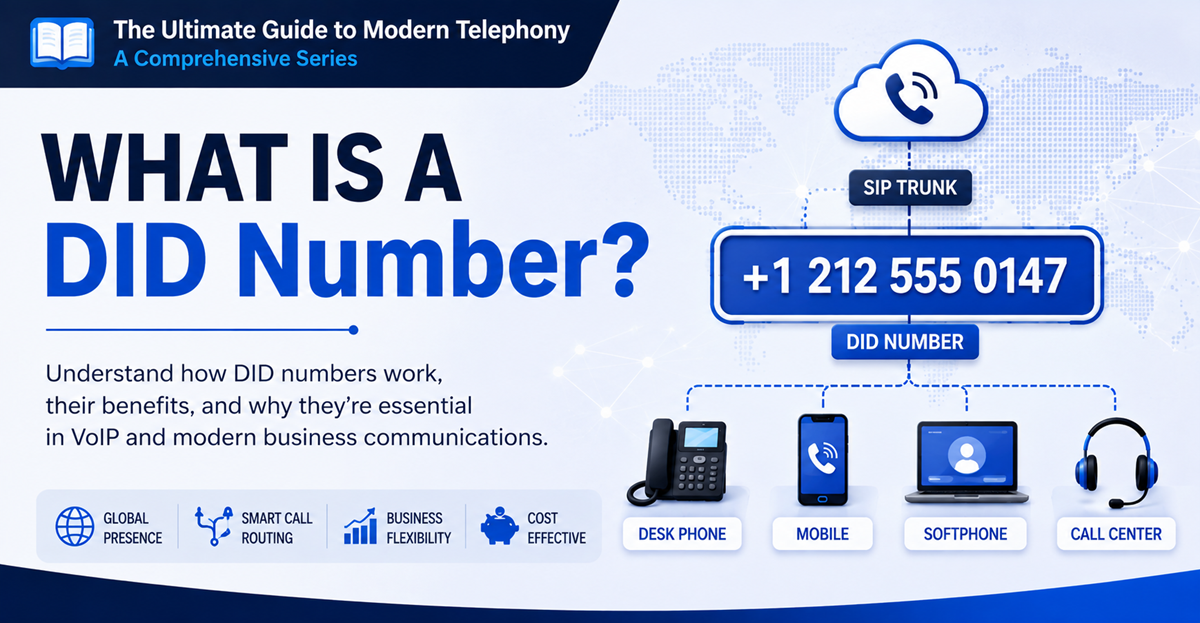
In this educational series, we are following the technologies behind modern communications. We started with the PSTN, explored VoIP and SIP, and then looked at SIP trunking, which connects business communications systems with telecommunications providers. That brings us naturally to DID numbers and the role they play in routing incoming calls.
What is a DID number? How Direct Inward Dialing works
If you have ever called a business number and reached a specific person directly without going through a receptionist, you have already experienced the idea behind Direct Inward Dialing (DID).
So, what is a DID number?
A DID number is a public telephone number provisioned for Direct Inward Dialing. It allows incoming calls to be routed to a specific destination within a business communications system. That destination might be an employee, department, call queue, auto attendant, conference service, contact center, or another application.
Modern DIDs are particularly important in VoIP and cloud communications because the destination no longer has to be a physical device or line. A number can be associated with a logical destination defined within the communications platform.
This makes DID numbers an important link between the familiar world of telephone numbers and modern IP communications.
Where DID numbers came from
To understand what a DID number is, it helps to return briefly to the history of business telephony.
Organizations traditionally used a Private Branch Exchange, or PBX, to connect internal telephone extensions. Instead of purchasing a separate external telephone line for every employee, the PBX allowed many users to share a smaller number of connections to the public telephone network. Incoming calls, however, still needed to reach the right person.
One solution was a switchboard operator. A caller would dial the company’s main phone number, tell the operator whom they wanted to speak with, and then be connected to the appropriate extension.
Direct Inward Dialing automated much of this process. Telephone carriers could provide a range of numbers to the organization. The PBX could then associate those numbers with internal extensions. Someone outside the company could dial an employee’s DID and reach the appropriate destination directly.
As PBXs evolved from physical hardware to software and cloud platforms, the concept became even more flexible.
How DID numbers work
Once you understand what a DID number is, the next question is how the call actually reaches its destination.
Imagine a company has assigned a DID number to Alice. A customer dials Alice’s business number from a mobile phone. The originating telephone network processes the dialed number and routes the call toward the telecommunications provider serving that number. That provider then delivers the call to the company’s communications environment.
In a modern VoIP deployment, this might happen through a SIP trunk, which we explored in the previous article.
The company’s PBX receives the called-number information. It checks its routing configuration and determines that this particular DID should be delivered to Alice. Her phone or softphone rings.
The same principle can be applied to far more than individual users. The PBX could route another DID to the sales department, another to customer support, and another directly to an automated application.
Not all DIDs need a physical line
This is an important part of understanding what a DID number is in modern telecommunications. A DID does not necessarily correspond to its own physical telephone line.
In an IP-based communications environment, phone numbers and call capacity can be managed separately. A business might have hundreds or thousands of DIDs, while its SIP service is configured to support a smaller number of simultaneous external calls based on actual usage.
For example, an organization with 500 employees might give every employee an individual business number. That does not mean all 500 employees will be making or receiving external calls at exactly the same moment.
This separation provides much more flexibility when designing business communications systems.
What are VoIP DIDs?
To understand what is a DID number in a VoIP environment, it helps to look at how DID numbers are delivered through VoIP services. The term VoIP DID generally refers to a DID number delivered to a customer through a VoIP or IP-based communications service.
For callers, the experience remains familiar: they dial a standard phone number and reach the configured destination. Behind the scenes, however, VoIP DIDs can be extremely flexible.
A DID can be routed to an IP PBX, hosted PBX, softphone, contact center, Unified Communications platform, or cloud application. Depending on the communications system, calls can also be forwarded to other destinations according to schedules, availability, business rules, or failover conditions.
That means the number becomes a stable way for callers to reach an organization even while the technology behind that number changes.
DID numbers and SIP trunking
The relationship between DID numbers and SIP trunks is particularly important.
In our previous article, we described a SIP trunk as an IP-based connection between an organization’s communications system and a telecommunications provider. DIDs give callers telephone numbers through which they can reach destinations on that system.
Suppose a business obtains 50 DID numbers from its provider. When someone calls one of those numbers, the provider can send the call through the SIP trunk to the company’s PBX. The SIP signaling contains information the PBX can use to identify the called number. The PBX then applies its routing rules and sends the call to the appropriate destination.
For outgoing calls, an authorized DID may also be used as the caller ID presented to the person receiving the call, subject to provider policies, verification requirements, and applicable rules.
Together, SIP trunks and DIDs give businesses considerable control over how external telephone calls enter and leave their communications environments.
The confusion between DID numbers and extensions
Another important part of answering what is a DID number is understanding the difference between a DID and an extension. The two are easy to confuse because both can identify individual users.
An extension is generally an internal identifier within a business phone system. Alice might have extension 205, for example, allowing colleagues to reach her by dialing 205 internally. Her DID could be a complete public telephone number that customers can dial from outside the organization. The PBX can associate that public number with extension 205 so that both routes eventually reach Alice.
This arrangement gives employees the convenience of short internal extensions while providing external callers with regular telephone numbers.
DID number routing
To fully understand what is a DID number, it is also useful to understand how DID routing works. A modern DID can participate in sophisticated routing rules.
For example, an employee’s DID number might first ring their desk phone and softphone. If they do not answer, the call could be forwarded to another colleague or voicemail. A support number could lead to an IVR and then to different queues depending on what the caller selects. A sales DID might ring several team members according to a predefined distribution strategy.
The exact possibilities depend on the PBX, VoIP platform, and provider configuration. This is one reason DID-based routing can be so flexible. The DID identifies the called number, while the communications platform determines what happens after the call arrives.
Why businesses use DID numbers
Businesses use DID numbers primarily because they provide flexible and efficient call routing.
Giving employees or departments their own numbers allows customers to reach the intended destination directly. This can reduce unnecessary transfers and make communication more convenient.
When businesses investigate what is a DID number and how it can support their communications strategy, geographic flexibility is often one of the main benefits. DIDs can help organizations establish a presence across different geographic markets. Subject to local regulations and provider availability, a company may obtain numbers associated with different cities or countries and route all those calls into the same communications platform. This is particularly useful for distributed businesses and customer service operations.
Another benefit is organizational flexibility. Because VoIP DIDs can be associated with logical destinations, companies can change where calls are delivered without necessarily changing the number customers already know.
DID numbers in cloud communications
Understanding what is a DID number also explains why DIDs are so useful in cloud communications. As business phone systems have moved to the cloud, DID routing has become increasingly flexible.
A company’s employees may now work from headquarters, satellite offices, homes, or different countries. Their business numbers can remain consistent while the underlying communications platform routes calls to whichever authorized devices or applications they use.
This means a business phone number can have a long lifespan even as an organization changes offices, replaces phone hardware, or migrates its communications infrastructure to the cloud.
Number portability can further support this continuity by allowing businesses to transfer eligible numbers between service providers, subject to telecommunications regulations and technical availability.
For customers, the familiar number remains the same. Behind it, the communications architecture can evolve considerably.
DID numbers and contact centers
DID numbers are also valuable for contact centers.
An organization might use different numbers for sales, technical support, billing, marketing campaigns, languages, brands, or geographic regions. Because the communications platform knows which DID was called, it can use that information when deciding how to handle the interaction.
A company operating in several countries, for example, might provide customers with local numbers in each market. Calls to those numbers could eventually reach agents working from a centralized or distributed contact center.
The same concept can help businesses measure campaign attribution. Different campaigns can use different telephone numbers, allowing the organization to identify which number generated a particular incoming call.
What is a DID number in the age of Voice AI?
Understanding what is a DID number has become even more relevant as Voice AI creates another chapter in the history of the telephone number. Fundamentally, its role remains familiar. It gives callers a reachable telephone number and allows the communications platform to route the incoming call to the appropriate destination. That destination can now include a voice AI agent.
A customer might dial a standard number from a mobile phone. The call travels through telephone and IP networks, enters a cloud communications platform, and is routed to an AI system capable of having a real-time voice conversation.
Different DIDs could even route calls to different AI agents, languages, services, brands, or workflows.
This shows why traditional telecommunications concepts continue to matter as AI transforms the industry. New applications still need to connect with people who understand one simple instruction: call this number.
Why understanding DIDs still matters
Understanding what is a DID number adds another important piece to the telecommunications picture.
The PSTN interconnected public telephone networks so calls could reach telephone numbers worldwide. VoIP moved voice onto IP networks. SIP provided signaling for establishing communication sessions, while SIP trunking gave business communications systems an IP-based connection to telecommunications providers.
The DID number provides a public identity that callers can use to reach a specific destination within those systems.
And once a call reaches the organization, another technology needs to decide how users, extensions, features, and call routing should work together.
That brings us naturally to the next article in this series. What is a hosted PBX? We will explore how the traditional business telephone exchange evolved into a software-based service delivered from the cloud. Because that change laid much of the groundwork for today’s Unified Communications and AI-powered business communications.


Leave a comment