
Answering emails and phone calls, sending feedback, attending meetings – if this is the kind of situation you face every day, you’ll be happy to know there’s a better, more productive way to communicate with your team. Let’s see how you can gain more control of your time and reduce the number of disturbing factors.
Posts in Category: products
Get more done and limit unnecessary distractions at work 🙂 We all agree that is important. And it’s not just because we work more than half of our waking hours, but also due to the amount of time we spend not doing our actual job. We put in less time writing, creating, coding, designing, or whatever we’re good at than sitting in meetings, emailing, briefing and debriefing, giving feedback. All in all, we spend a lot of time doing everything we can so that, at the end of the day, the whole team is on the same page.

Did you see it the last time you logged in on Hubgets? Or maybe after we’ve asked you to refresh the page because we have some new features for you. It’s entirely possible you just clicked on a status update and found it. But yeah, it’s true. We now have a neat Team Board ready to gather all your teammates’ status updates in one place.
Emoji has been the word of the year in 2015 and for good reasons: it’s everywhere! From social media posts to chats and advertising campaigns, these tiny ideograms and smileys have taken over the world 😀 Since images speak louder than words, they’ve turned into a fun form of digital communication. And we’re big fans ❤️
Sometimes emojis say it better
Think about it this way – scientists have proven that emojis come with great benefits for teamwork and collaboration. Writing takes away important non-verbal information, and this is how we can counter it. It’s not just about embellishment, these quirky characters can turn into stand alone sentences and speak volumes. When working with other people, not only they save space, but they also convey emotion. The messages are no longer dry, they have a personal touch, and express the creativity of the sender.
Language is dynamic and it’s greatly shaped by the people using it. With emojis, you can witness the development of a personal language and inside jokes, specific to teams. Being informal and natural will turn into a great business asset.
Introducing the new emoji set in Hubgets
We already told you that Hubgets ❤️ emojis. This is why we have integrated a library with many categories. Since there are over 880 of them to pick out from, you won’t have any trouble expressing your feelings or making creative combinations. A world of possibilities lies ahead 🙂
Our emojis are compatible with the default sets on several devices and operating systems, so things won’t get lost in translation.
And using them is really a piece of cake on Hubgets. You can just click the icon and insert one.
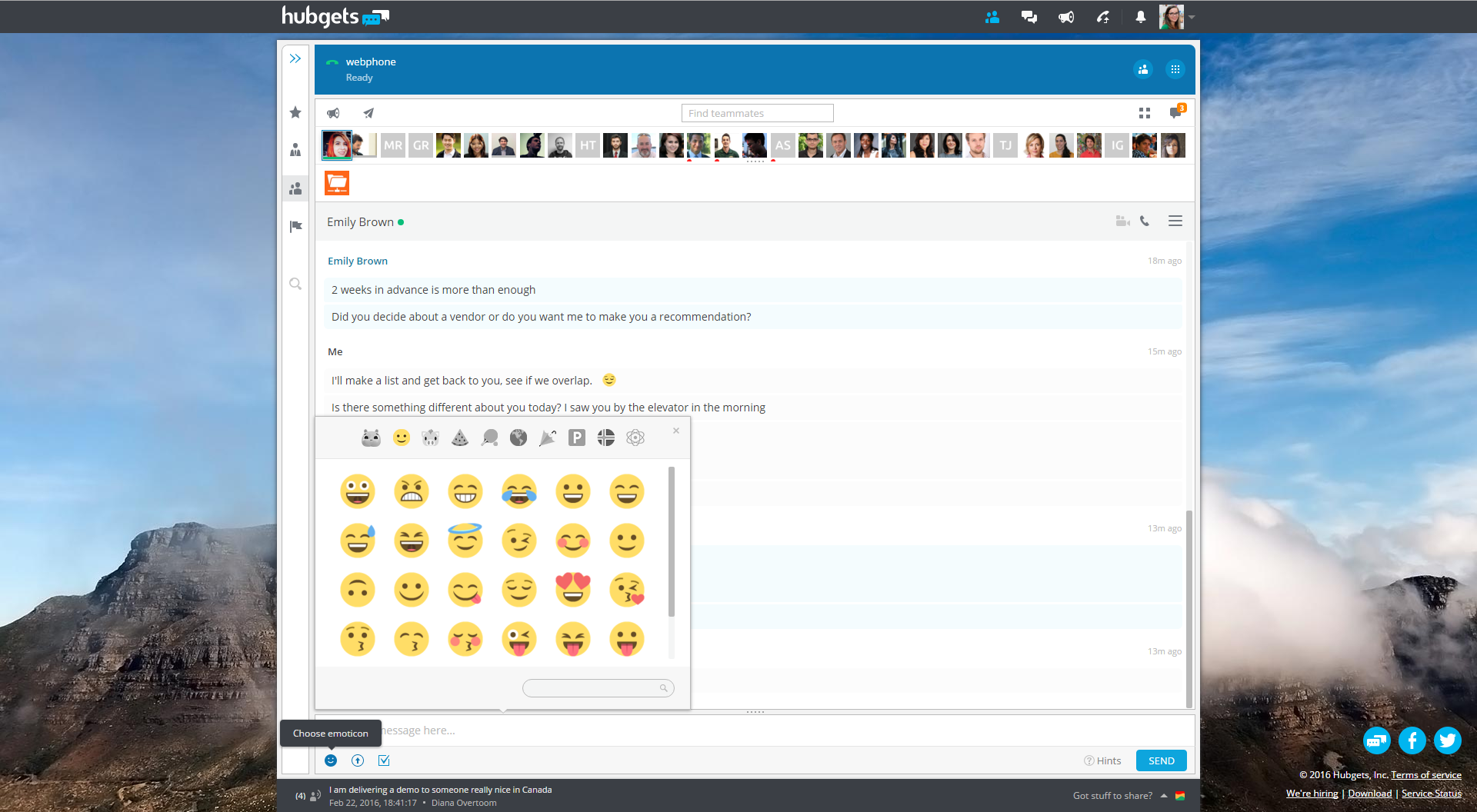
Inserting an emoji

Researchers have discovered and announced a major flaw in one of the building blocks on Linux operating system – the GNU C Library. The vulnerability has been reported as CVE-2015-7547 and was disclosed on Tuesday, February 16, 2016. The vulnerability is in function getaddrinfo() that performs domain-name (DNS) lookups.

For years, the web vs. desktop apps rivalry has led to passionate debates and dramatic terms like battles and wars. This article does not champion either of these environments. It’s just a personal account of how I dealt with the web vs. the desktop dilemma so that I could make the most of Hubgets, on my own terms.
Time is a bloody tyrant, Shakespeare said. No offense, Shakespeare, but in this century so is information. Think about it this way – when you’ve got too much information on your hands and scarce to zero means to organize it, you usually get swamped. When you’re lacking information, it’s hard to make a decision, let alone a knowledgeable one. So, either way, you’re at the mercy of information – it’s like The Taming of the Shrew all over again 😀
Let’s see how lack of information translates in the workplace and how teams can use Hubgets to overcome that.
We’ve all been in a tight spot where a super urgent task falls on your head, requiring you to get in touch with people you don’t usually work with. No matter how you look at it, getting everyone in one place is time-consuming. First, you need to consider the logistics behind an urgent task/crisis meeting. Then, you can’t be oblivious to the time people need to disconnect from a task and connect to another. Adjusting to a new context and reaching a high level of implication requires an amount of time that urgent tasks never offer.

We developed Hubgets with the goal to make our teamwork as smooth as possible. Then, we shared it with the world. With Hubgets, you can have cohesive teams and a flexible work policy. You can reach people half way across the globe using the same mechanism you would to buzz a colleague 10 feet away. Today, we’ll look at the Phone component in Hubgets.
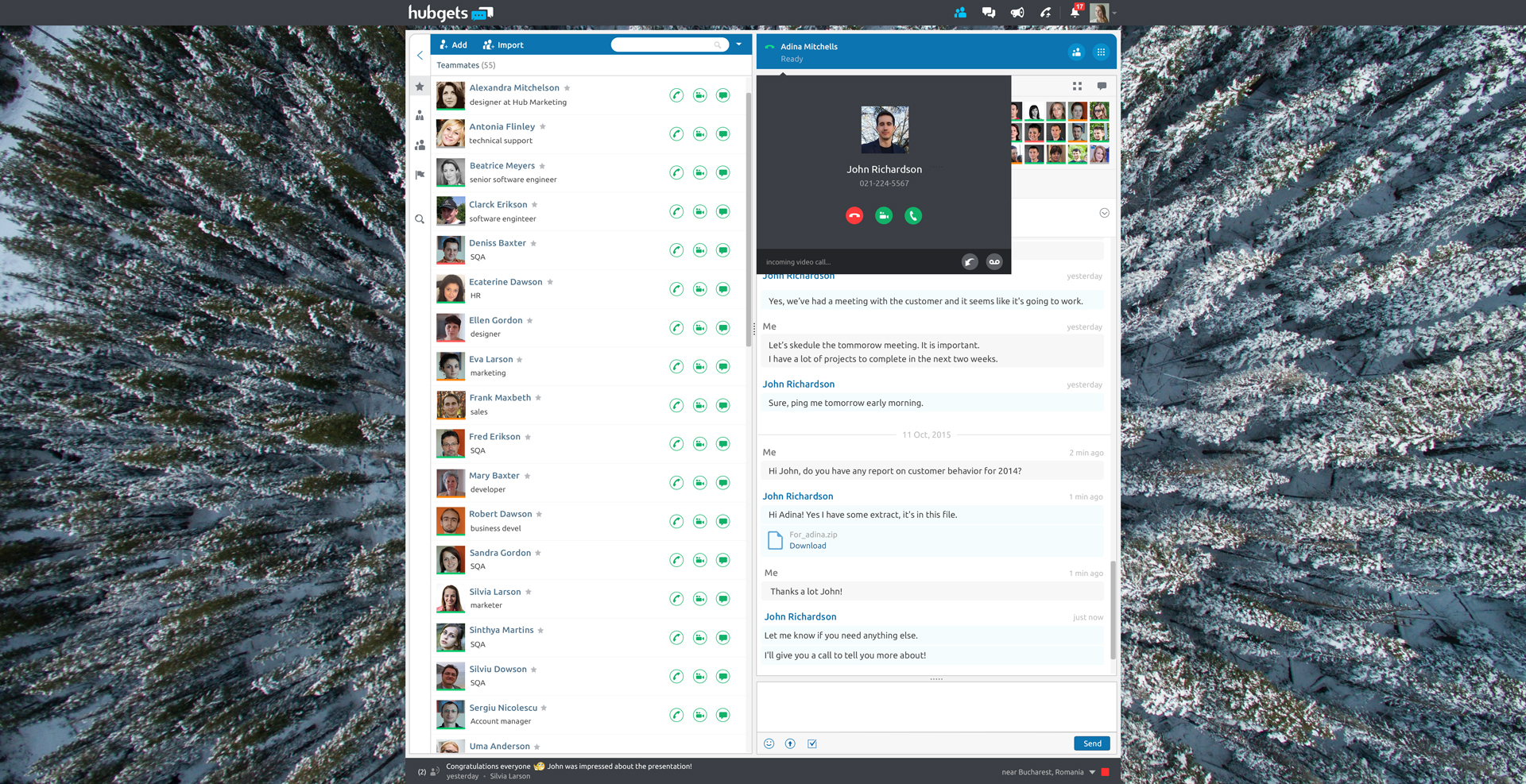
Hubgets Phone

Photo by rawpixel on Unsplash
Communication infrastructures established in the ’90s are becoming increasingly incompatible with today’s connected economy. When it takes too long for partners to connect, or to fulfill customer needs, you know there’s a problem somewhere. For every problem, there’s a solution.
Unified Communications (UC) was born out of the need to enable faster decision making, but also to make collaboration more efficient. UC merges real-time communications (voice, video, instant messaging) with real-time data (presence, file sharing), and we often end up using the term Unified Communications & Collaboration (UC&C) to describe these solutions. Provided as-a-service, UC&C has a series of technical and financial advantages that make it a key asset for virtually any business today


