
Did you see it the last time you logged in on Hubgets? Or maybe after we’ve asked you to refresh the page because we have some new features for you. It’s entirely possible you just clicked on a status update and found it. But yeah, it’s true. We now have a neat Team Board ready to gather all your teammates’ status updates in one place.

We started thinking about Hubgets many years ago. We didn’t want to build yet another instant communication platform, but solve a problem that emerged five years ago and which, today, seems to have become much worse. Funny enough, last week I read this article
Every March, excitement takes over our office. Everyone gets giddy and it’s quite clear we’re just counting down the days ’till a new edition of Cool Summer Internship! This is the exact situation we’re in right now, so let’s take a closer look at what we have in store for this year 🙂
Let’s meet
We’re debuting our 8th internship program during the LSAC IT&C Job Fair today. We’re welcoming brilliant future engineers to our presentation at the Automation and Computers Faculty. Let’s meet in EC105 hall starting 2 PM. This is a great opportunity for all students to find out more about us, what we’re working on and what it takes to become one of our Clouders. Both our CEO, Bogdan Carstoiu, and our newest Clouders will have interesting stories to share.
Emoji has been the word of the year in 2015 and for good reasons: it’s everywhere! From social media posts to chats and advertising campaigns, these tiny ideograms and smileys have taken over the world 😀 Since images speak louder than words, they’ve turned into a fun form of digital communication. And we’re big fans ❤️
Sometimes emojis say it better
Think about it this way – scientists have proven that emojis come with great benefits for teamwork and collaboration. Writing takes away important non-verbal information, and this is how we can counter it. It’s not just about embellishment, these quirky characters can turn into stand alone sentences and speak volumes. When working with other people, not only they save space, but they also convey emotion. The messages are no longer dry, they have a personal touch, and express the creativity of the sender.
Language is dynamic and it’s greatly shaped by the people using it. With emojis, you can witness the development of a personal language and inside jokes, specific to teams. Being informal and natural will turn into a great business asset.
Introducing the new emoji set in Hubgets
We already told you that Hubgets ❤️ emojis. This is why we have integrated a library with many categories. Since there are over 880 of them to pick out from, you won’t have any trouble expressing your feelings or making creative combinations. A world of possibilities lies ahead 🙂
Our emojis are compatible with the default sets on several devices and operating systems, so things won’t get lost in translation.
And using them is really a piece of cake on Hubgets. You can just click the icon and insert one.
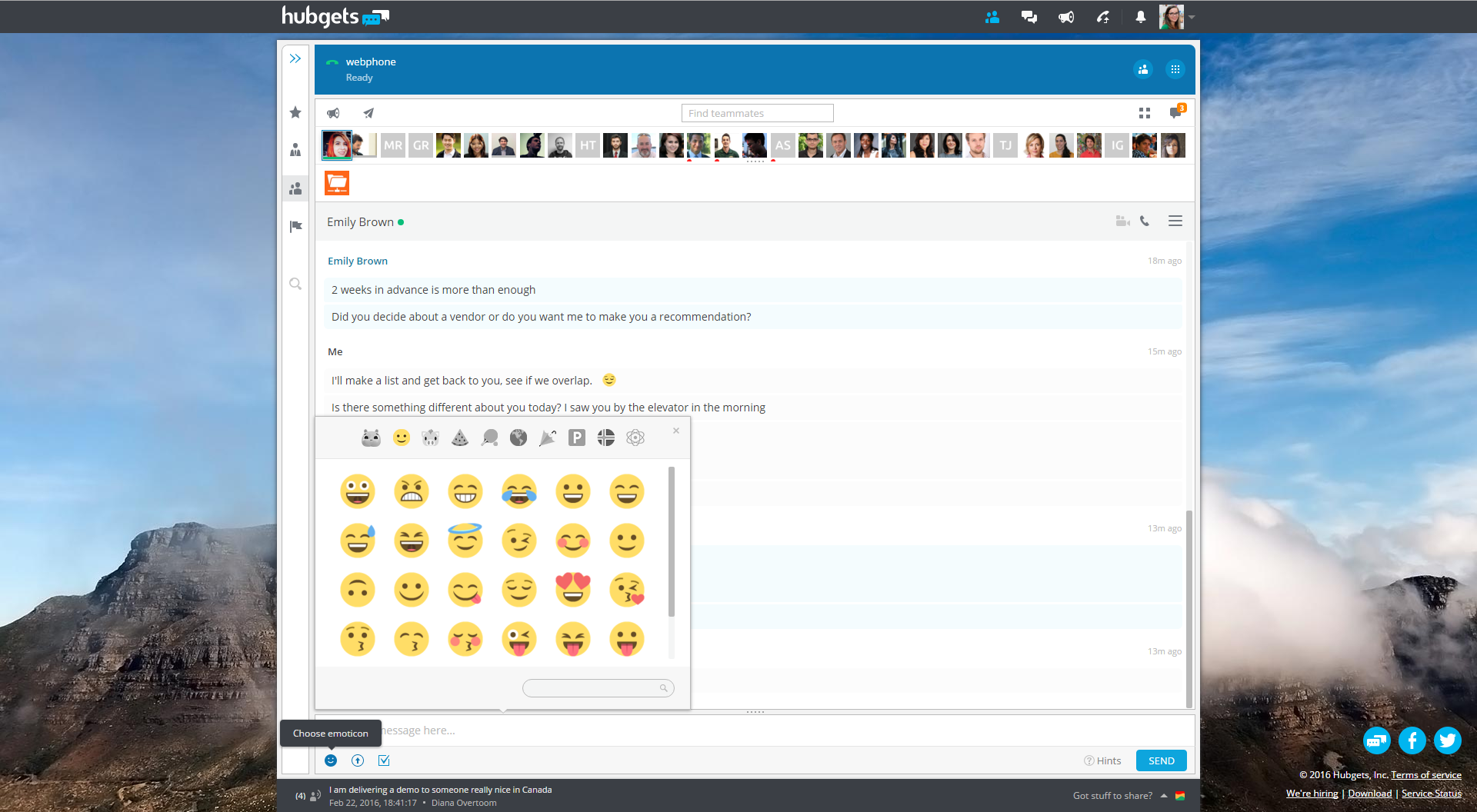
Inserting an emoji

Coming together is the beginning; staying together is progress; working together is success. Henry Ford said that a long time ago, but don’t we wish for the same thing in the workplace too? As with most things, it’s easier said than done. How exactly do you make beginnings happen the right way, and how can you ensure they grow into a long-term experience?


Researchers have discovered and announced a major flaw in one of the building blocks on Linux operating system – the GNU C Library. The vulnerability has been reported as CVE-2015-7547 and was disclosed on Tuesday, February 16, 2016. The vulnerability is in function getaddrinfo() that performs domain-name (DNS) lookups.

There’s a very good reason why I zone out when I have something to finish fast. That reason is usually associated with an annoying voice, but today it was associated with puppy eyes. Seriously, I feel that this is the best strategy to undermine a team’s focus under deadline. Enter #uberPuppies!

For years, the web vs. desktop apps rivalry has led to passionate debates and dramatic terms like battles and wars. This article does not champion either of these environments. It’s just a personal account of how I dealt with the web vs. the desktop dilemma so that I could make the most of Hubgets, on my own terms.

Time is a bloody tyrant, Shakespeare said. No offense, Shakespeare, but in this century so is information. Think about it this way – when you’ve got too much information on your hands and scarce to zero means to organize it, you usually get swamped. When you’re lacking information, it’s hard to make a decision, let alone a knowledgeable one. So, either way, you’re at the mercy of information – it’s like The Taming of the Shrew all over again 😀
Let’s see how lack of information translates in the workplace and how teams can use Hubgets to overcome that.
We’ve all been in a tight spot where a super urgent task falls on your head, requiring you to get in touch with people you don’t usually work with. No matter how you look at it, getting everyone in one place is time-consuming. First, you need to consider the logistics behind an urgent task/crisis meeting. Then, you can’t be oblivious to the time people need to disconnect from a task and connect to another. Adjusting to a new context and reaching a high level of implication requires an amount of time that urgent tasks never offer.


